
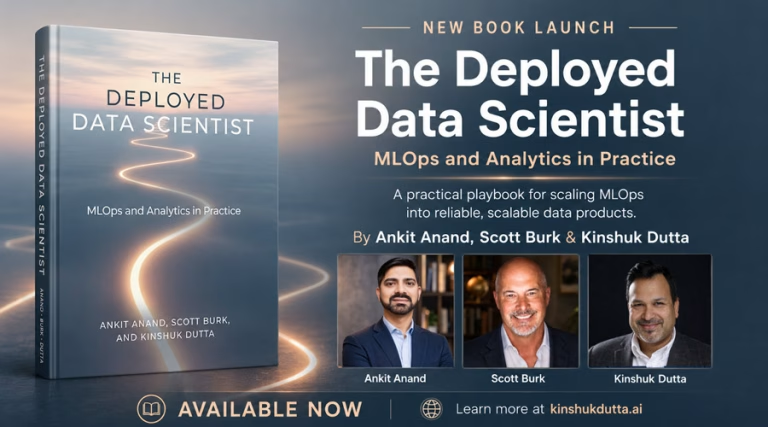
New Book Explores the Real Challenge of Enterprise AI: Making It Work Beyond the Pilot Stage
NEW YORK, June 2026 — Artificial Intelligence has captured the attention of boardrooms, investors, and technology leaders worldwide. Organizations continue to invest aggressively in machine learning, advanced analytics, Generative AI, and autonomous systems, hoping to unlock new efficiencies and competitive advantages.
Yet beneath the excitement lies a persistent reality: many AI initiatives never evolve beyond experimentation. While models may demonstrate impressive results in development environments, far fewer survive the transition into dependable business systems that can operate, scale, and deliver value consistently.
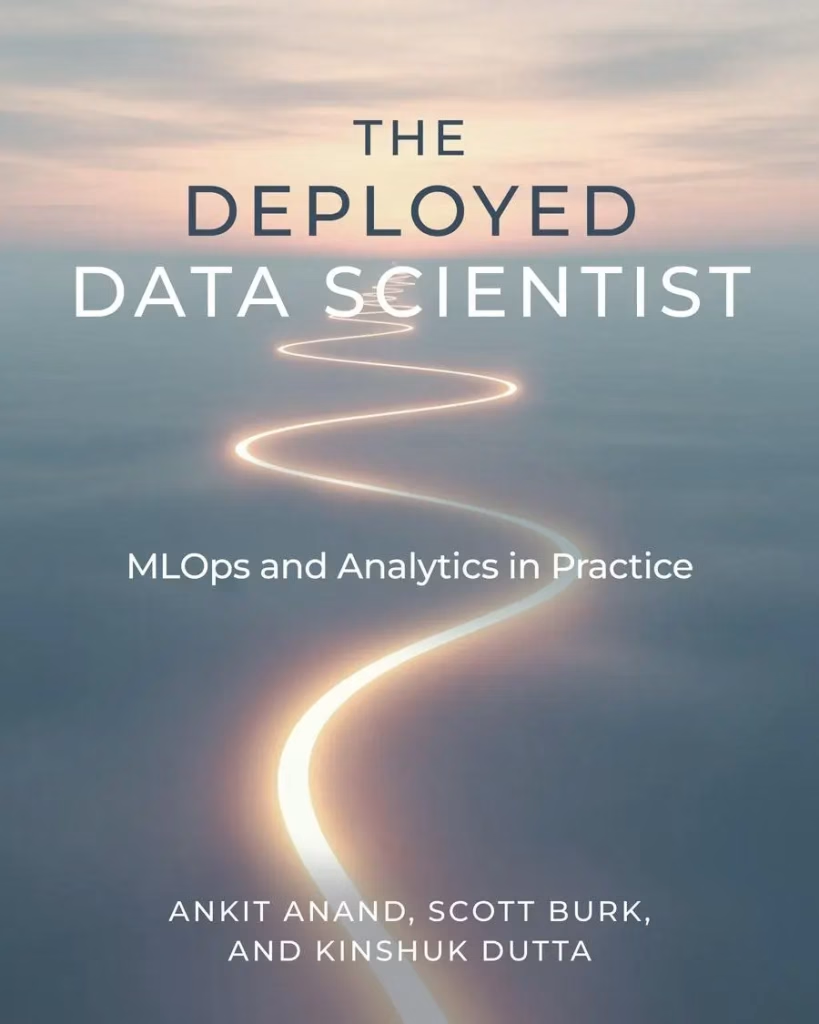
This growing disconnect between innovation and execution is the focus of a newly released book, The Deployed Data Scientist: MLOps and Analytics in Practice, authored by enterprise AI practitioners Ankit Anand, Dr. Scott Burk, and Kinshuk Dutta.
The book argues that the future of AI success will depend less on creating smarter algorithms and more on building the operational capabilities required to support them in production.
The Enterprise AI Maturity Gap
For years, organizations have measured AI progress by the sophistication of their models. However, as adoption accelerates, many leaders are discovering that technical achievement alone rarely translates into business transformation.
Production environments introduce challenges that rarely appear during experimentation. Data pipelines break. Models drift. Governance requirements evolve. Monitoring becomes increasingly complex. Ownership becomes fragmented across departments. Compliance expectations intensify.
Without a structured operational framework, even the most promising AI initiatives can struggle to deliver lasting results.
According to the authors, this is where many organizations encounter what they describe as the “AI maturity gap”—the space between building a model and operating an intelligent system at scale.
Voices from the Industry
Industry leaders increasingly recognize that operational excellence is becoming the defining factor in AI success.
“The organizations that gain long-term advantage from AI will be those that treat it as a business capability rather than a technology experiment. Reliability, governance, transparency, and operational rigor are becoming essential. This book offers practical guidance for making that transition.”
— Partha Ghosh, CEO, MaiTY (NeurCG GmbH)
Rethinking What It Means to Deploy AI
The authors challenge a common assumption in the AI community: that deployment marks the end of a project.
Instead, they position deployment as the beginning of a continuous operational lifecycle that requires active management, governance, oversight, and improvement.
“Many discussions around AI focus on models and algorithms. However, organizations create value when those models become trusted business assets supported by strong operational processes.”
— Kinshuk Dutta
“The industry has become very effective at proving that AI can work. The next challenge is proving that it can continue working reliably, securely, and efficiently under real-world conditions.”
— Ankit Anand
“The true measure of AI success is not model accuracy in isolation. It is the ability to continuously govern, monitor, improve, and scale intelligent systems while delivering measurable business outcomes.”
— Dr. Scott Burk
What Readers Will Learn
Designed for data leaders, AI practitioners, architects, engineers, and executives, The Deployed Data Scientist provides practical guidance for establishing sustainable AI operations.
Topics explored throughout the book include:
- Enterprise data engineering practices
- Machine learning operationalization
- MLOps frameworks and methodologies
- Continuous integration and deployment for AI
- Cloud-native AI architectures
- Monitoring and observability strategies
- Model drift management
- Human oversight and decision controls
- LLMOps and Generative AI governance
- Organizational accountability models
- Production-ready AI operating frameworks
The authors emphasize that successful AI systems should be viewed as living products that evolve continuously rather than projects that end after deployment.
Navigating the Next Generation of AI
The rapid rise of Large Language Models, intelligent agents, and Generative AI applications has introduced new operational considerations for enterprises.
Organizations now face questions that extend beyond traditional machine learning:
- How should AI-generated outputs be monitored?
- What governance controls should exist around prompts and context?
- How can enterprises maintain transparency and explainability?
- What safeguards are necessary to support regulatory compliance?
- How should businesses evaluate and manage autonomous AI behavior?
The book contends that answering these questions requires a blend of engineering discipline, governance structures, trusted data foundations, and business accountability.
Connecting Data, Operations, and Intelligence
The publication also reflects a broader philosophy shared by the authors: successful AI initiatives emerge when organizations align data strategy, governance, operations, engineering, and business objectives.
This perspective spans several interconnected areas:
- Building trustworthy data ecosystems
- Strengthening governance and stewardship practices
- Establishing scalable AI deployment frameworks
- Supporting Agentic AI and autonomous systems
- Creating responsible and sustainable AI environments
Together, these disciplines create the foundation for enterprise intelligence that can grow safely and reliably over time.
Questions Driving the Conversation
The Deployed Data Scientist addresses many of the concerns currently facing technology and business leaders, including:
- Why do so many AI projects struggle after proof-of-concept?
- What capabilities distinguish production AI from experimentation?
- How can enterprises build trust in machine learning systems?
- What role does observability play in operational success?
- How should organizations manage Generative AI responsibly?
- Which governance controls are essential for AI at scale?
- What organizational structures support effective MLOps?
- How can companies create durable AI operating models?
Built on Decades of Enterprise Experience
Drawing from more than 75 years of combined experience, the authors bring perspectives shaped by work across enterprise technology, analytics, artificial intelligence, academia, consulting, software development, governance, and digital transformation.
Their collective background spans Fortune 500 organizations, research institutions, technology providers, and educational programs, offering readers practical insight into the realities of implementing AI in complex business environments.
About the Authors
Ankit Anand
Ankit Anand is a Data Management Architect, inventor, AI researcher, and technology executive whose work focuses on enterprise data strategy, governance, analytics modernization, machine learning infrastructure, and trusted AI ecosystems. He has led numerous initiatives centered on improving data quality, operationalizing analytics, and enabling large-scale AI adoption.
Dr. Scott Burk
Dr. Scott Burk is a statistician, educator, author, and enterprise analytics leader. He serves as an Adjunct Professor in the Master of Science in Data Science program at the CUNY School of Professional Studies. Over a career spanning more than three decades, he has worked across healthcare, financial services, software, and technology sectors.
His published works include The Executive Guide to AI and Analytics, Data for AI, AI Agents at Work, the It’s All Analytics series, and The Deployed Data Scientist. He is also the founder of The Data Linguist, an educational platform dedicated to analytics, data science, and AI learning.
Kinshuk Dutta
Kinshuk Dutta is a technology executive, author, speaker, and IEEE Senior Member with expertise in Master Data Management, Data Governance, MLOps, Agentic AI, and enterprise AI implementation. As co-author of Data for AI, AI Agents at Work, and The Deployed Data Scientist, his work examines the journey from trusted data foundations to intelligent systems operating at enterprise scale. He currently serves as Head of Go-To-Market, Americas, for ON EBX, a Cloud Software Group business unit.
Looking Ahead
As AI moves from experimentation to enterprise-wide adoption, organizations are beginning to recognize that long-term success depends on much more than model development. Sustainable value emerges when technology is supported by strong operational practices, trusted data, governance, and accountability.
The Deployed Data Scientist contributes to this conversation by offering a practical roadmap for organizations seeking to transform AI from isolated innovation into a dependable business capability.
Knowledge grows when shared. Please Pass it on!

Discover more from Paxjones
Subscribe to get the latest posts sent to your email.