
A Purpose Built Tool for Serious Chess Reflection
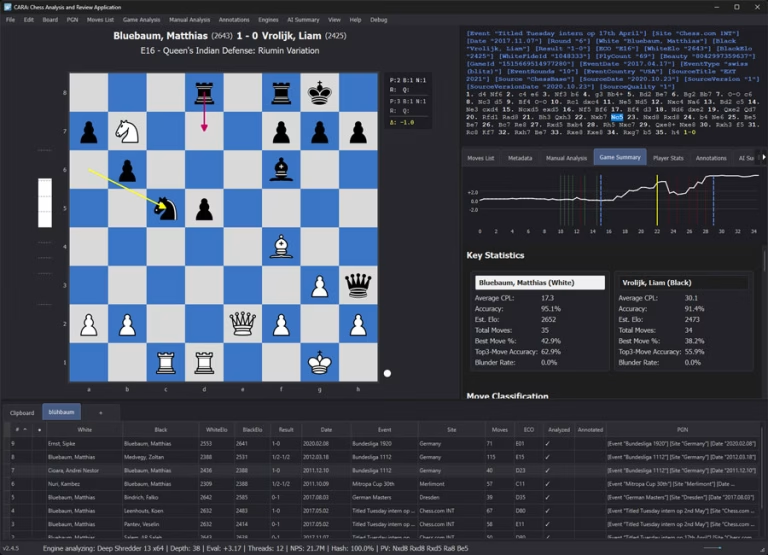
CARA, known fully as the Chess Analysis and Review Application, is a free open source desktop application created for players who want to learn deeply from their own games. Available on both Windows and macOS, CARA focuses entirely on analysis and review rather than gameplay or puzzles. Its purpose stays clear throughout the experience. It helps players understand decisions, uncover mistakes, recognize recurring patterns, and build stronger chess intuition over time.
The motivation behind CARA came from a sense of dissatisfaction with many existing chess analysis tools. Several popular options felt expensive, cluttered, and difficult to use in a real study routine. While they often produced large amounts of data, they rarely explained ideas in a way that supported genuine improvement. CARA was created to address this gap by offering a cleaner workflow, meaningful feedback, and insights that players can actually apply in future games.
Another unique aspect of CARA lies in how it was built. The project was developed largely with the assistance of an AI model, guided closely by the author’s architectural plans, coding standards, and user experience principles. This careful collaboration demonstrated how AI-assisted development can succeed when paired with strong human oversight, resulting in a polished and thoughtfully designed desktop application.
Organizing and Exploring Games with Ease
CARA provides a robust environment for managing chess games stored in PGN format. Users can open multiple databases at once, each displayed in its own tab for smooth navigation. Searching across games feels intuitive, with filters for player names, dates, openings, results, and more. Tools for deduplication and bulk editing simplify the process of maintaining clean and consistent databases. Importing games from local files or online platforms such as Lichess and Chess.com fits naturally into the workflow.
At the center of the application sits a visually refined interactive chessboard. It communicates information clearly while remaining easy on the eyes. Played moves appear with arrows, while engine-suggested alternatives and principal variations show up during analysis. MultiPV arrows allow users to explore several candidate moves at once. A positional heatmap adds another layer of understanding by highlighting features like piece activity, weak squares, and king safety. Every visual element can be adjusted or hidden, giving players full control over how much information they see.
Game analysis uses UCI-compatible engines and applies a thorough evaluation process to each move. CARA compares positions before and after a move, calculates Centipawn Loss, and assigns clear classifications such as Inaccuracy, Mistake, or Brilliancy. This method provides context and helps players see how each decision affects the position as the game develops. Analysis can be performed on a single game or scaled across entire databases.
Turning Data into Insightful Summaries
After analysis, CARA presents a comprehensive game summary that brings clarity to complex data. Players receive accuracy scores, average Centipawn Loss values, and breakdowns of performance across opening, middlegame, and endgame phases. Key moments and evaluation swings stand out, making it easier to understand how momentum shifted during the game.
One of CARA’s standout features is its automatic highlight detection system. The application identifies dozens of tactical and positional patterns, including forks, pins, skewers, discovered attacks, and significant evaluation changes. These highlights are grouped by game phase, allowing players to quickly focus on critical moments. The rule-based design makes it easy to expand the system with new pattern detections in the future.
The moves list acts as a central hub for detailed per-move information. It displays move notation, evaluations, classifications, engine depth, material balance, and much more across a wide range of customizable columns. Users can create and switch between column profiles depending on their current study focus, whether that involves opening transitions, tactical errors, or material trends.
Advanced Study Features That Support Growth
CARA goes further by supporting deep manual analysis. Continuous engine evaluation remains active as users navigate through positions, while hovering over principal variation moves reveals miniature boards showing future positions. Positional plan exploration visualizes how pieces move through recommended engine lines, helping players understand long-term ideas rather than isolated moves.
Annotations offer another powerful learning tool. Text, arrows, circles, and square highlights can be placed freely on the board, resized, rotated, and customized in color. Annotations attach to specific positions and are stored efficiently within PGN metadata, keeping notation clean while preserving rich study notes.
Aggregated player statistics allow users to analyze performance across many games. CARA tracks tendencies, opening usage, phase-specific weaknesses, and recurring error patterns. Updates run asynchronously, ensuring smooth performance even with large databases.
An AI-powered summary interface adds a conversational dimension to analysis. Players can discuss positions with a language model that has access to engine evaluations, move data, and positional context. This feature supports reflection and reinforces understanding through dialogue.
CARA delivers a focused, thoughtful environment for chess improvement. It emphasizes clarity, learning, and long-term growth, offering players a reliable companion for serious post-game study.
Knowledge grows when shared. Please Pass it on!

Discover more from Paxjones
Subscribe to get the latest posts sent to your email.