

Finding Meaning Beyond History in Close Your Eyes to See: What If the Past Was Never Silent? by M.R. Gontu
Every generation inherits stories, monuments, and traditions from those who came before. Some people admire them from a distance, while others feel compelled to ask deeper questions. Close Your Eyes to See: What If the Past Was Never Silent? by M.R. Gontu is written for readers who enjoy looking beneath familiar narratives and discovering fresh ways to understand the past.
Rather than delivering a collection of fixed explanations, the book encourages thoughtful exploration. It reminds readers that curiosity has always been one of humanity’s greatest strengths and that meaningful discoveries often begin with a simple question.
When Childhood Curiosity Becomes a Lifelong Search
M.R. Gontu’s journey began during his childhood in India, where ancient temples sparked a fascination that never faded. Standing before remarkable stone structures surrounded by centuries of tradition, he experienced a sense of wonder that reached far beyond architecture. The symbols, carvings, and rituals inspired questions that remained with him as the years passed.
Life eventually led him to America, where he built a successful career in artificial intelligence and technology. Although his professional world focused on solving modern challenges, those early memories continued to shape his thinking. The same questions from childhood gradually returned with greater clarity, encouraging him to explore connections between history, knowledge, memory, and civilization.
This personal journey forms the foundation of Close Your Eyes to See. Instead of presenting history as a completed story, the book suggests that every generation has an opportunity to rediscover meanings that may have been overlooked. Readers are invited to participate in that process by examining familiar subjects through a fresh perspective.
Throughout the book, curiosity remains the guiding force. Questions about temples, repeating symbols, cultural traditions, and the choices made by ancient civilizations become opportunities for reflection rather than destinations with simple answers.
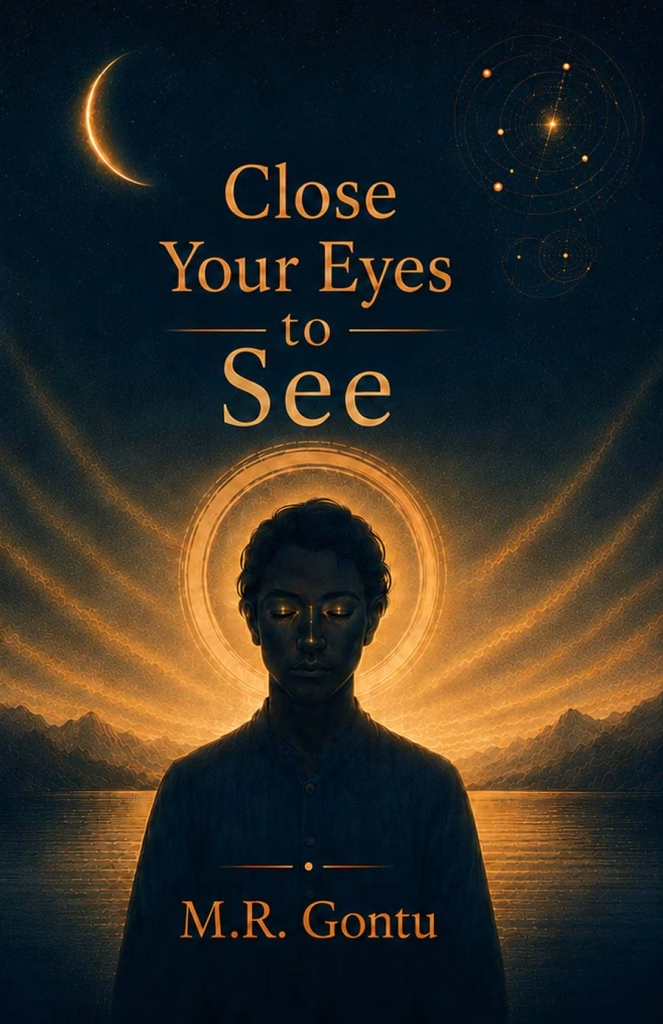
Exploring the Silent Messages Left Across Time
One of the book’s most engaging qualities is its ability to transform everyday assumptions into thoughtful conversations. Ancient temples become more than historical landmarks. They represent deliberate creations shaped by people who wanted their knowledge and beliefs to endure across generations.
The recurring symbols found throughout history receive similar attention. Instead of treating them as decorative elements, M.R. Gontu encourages readers to consider why these images continued to appear across different periods and places. Their persistence raises fascinating possibilities about memory, communication, and shared human experience.
Another important theme involves the preservation of knowledge. Civilizations invest enormous effort in creating lasting structures, traditions, and cultural practices. Over time, physical monuments often survive while their original meanings gradually fade. The author reflects on this reality with sensitivity, suggesting that forgotten understanding may sometimes be closer than people realize.
The title itself captures this central idea beautifully. Close Your Eyes to See encourages readers to move beyond surface observation and develop a deeper awareness of the ideas that history continues to offer. Seeing becomes less about physical sight and more about thoughtful reflection, careful observation, and openness to new perspectives.
Readers who enjoy philosophy, cultural history, archaeology, spirituality, or reflective nonfiction will likely appreciate the book’s calm and engaging style. It creates room for individual interpretation while maintaining an inviting conversational voice from beginning to end.
About the Author
M.R. Gontu is a technology professional and innovator with extensive experience solving complex problems through practical thinking and creative solutions. Writing a book was never part of his original plans. Over many years, however, the questions that had accompanied him since childhood continued to grow stronger. Close Your Eyes to See became his way of sharing those reflections with others. His goal is to offer readers another way of thinking about history, memory, and civilization while encouraging independent exploration rather than directing belief.
Why This Book Leaves a Lasting Impression
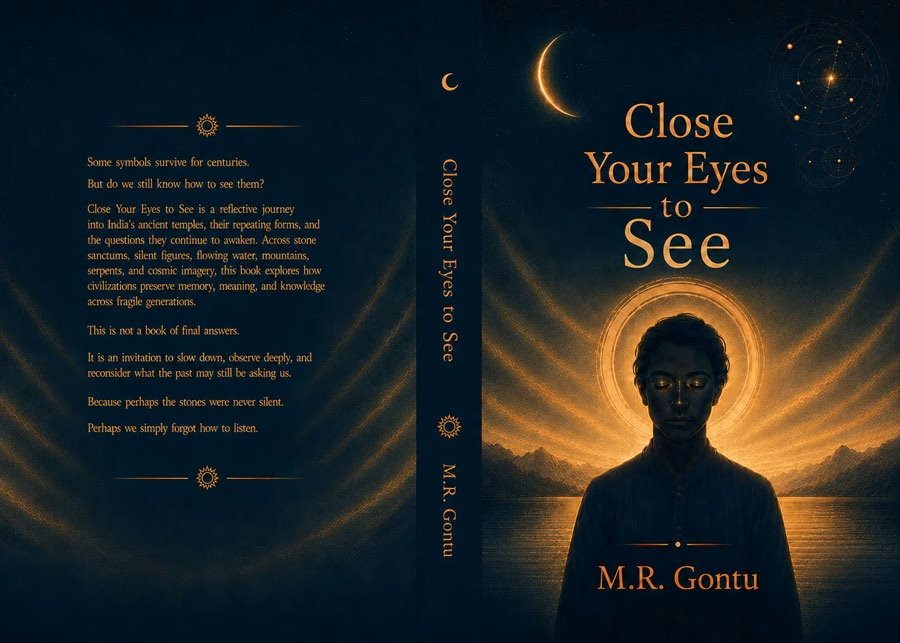
Close Your Eyes to See: What If the Past Was Never Silent? demonstrates that some of the most rewarding books are those that invite reflection instead of certainty. M.R. Gontu presents an engaging exploration of ancient civilizations through the lens of curiosity, encouraging readers to slow their pace and appreciate the enduring wisdom preserved within history.
Available on Amazon, the book offers an enriching experience for anyone who enjoys asking thoughtful questions and exploring ideas that continue to resonate across generations. Long after the final chapter, its central message remains clear. The past still speaks to those who are willing to observe carefully, reflect deeply, and remain curious about the world around them.
We had the privilege of interviewing the author. Here are excerpts from the interview:
Hi, thank you so much for joining us today! Please introduce yourself and tell us what you do.
I am a technology professional and innovator focused on solving complex problems and turning ideas into practical solutions. I never imagined writing a book. But for decades, I carried questions in search of answers—and when those answers finally began to take shape, Close Your Eyes to See became my response. It is not an attempt to persuade, but an offering of a different perspective.
Please share your journey with our readers.
I grew up around ancient Indian temples, fascinated by their architecture, symbols, rituals, and stories. I often wondered why generations had invested so much thought and devotion in creating and preserving them—and that wonder gave rise to my first questions.
Years later, when I began searching more deeply, connections emerged as though they had been waiting to be discovered, and I felt a calling to write them down.
Writing in the quiet margins of life meant borrowing time from my family, and I could not have completed this journey without the patience, love, and encouragement of my wife, Bhargavi. This journey is as much hers as it is mine.
What are the strategies that helped you become successful in your journey?
Curiosity helped me ask questions, patience allowed those questions to mature, and persistence carried me through. My background in technology taught me to connect ideas across different fields, while humility reminded me to present my interpretations as possibilities rather than conclusions.
Any message for our readers?
Approach inherited knowledge with neither blind acceptance nor immediate dismissal. Give it the time, curiosity, and openness it deserves.
The book examines symbols and traditions so familiar that we may feel we already understand them, yet they could carry meanings far deeper than what appears on the surface. I have shared the connections and interpretations I discovered along the way. Some readers may find them compelling, while others may see them differently—and both responses are welcome.
I believe we are still far from fully understanding what earlier generations left for us—knowledge and creations that sometimes appear almost beyond what seems humanly possible. If this book inspires even a little continued observation and exploration, it has done its work.
Thank you so much for giving us your precious time! We wish you all the best for your journey ahead!
Knowledge grows when shared. Please Pass it on!

Discover more from Paxjones
Subscribe to get the latest posts sent to your email.