
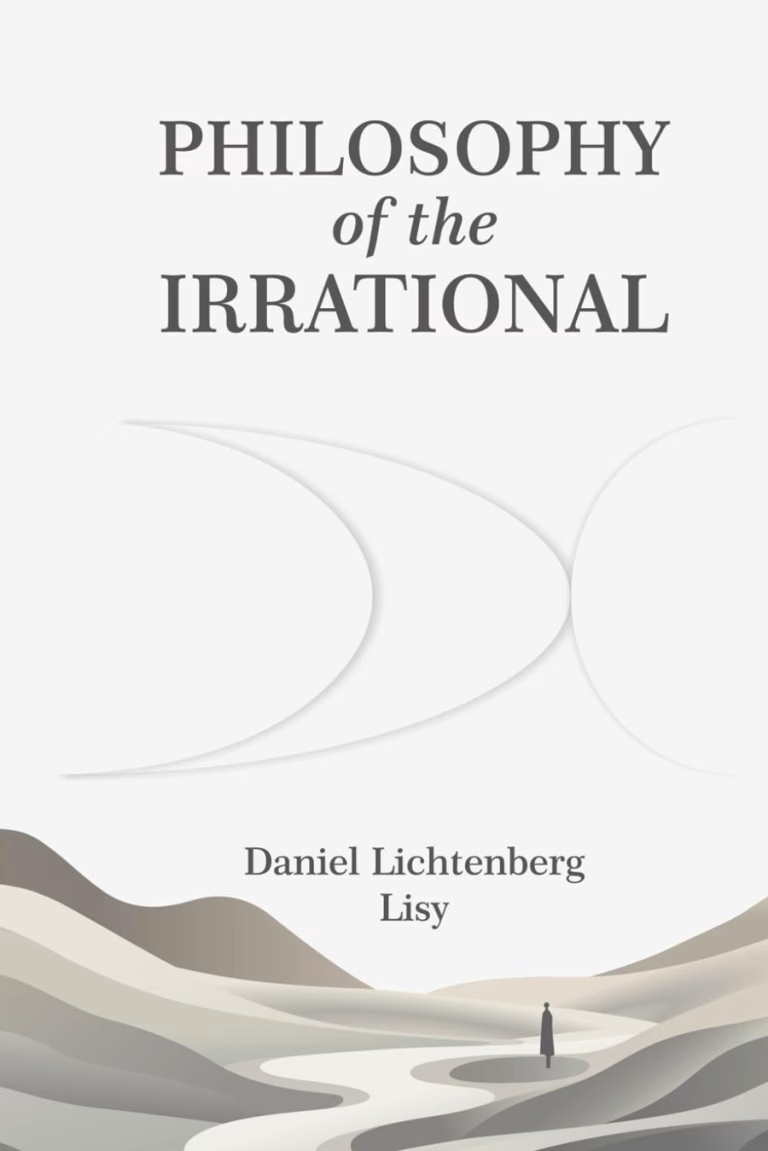
Some books invite readers to learn. Others invite them to rethink everything they assumed they knew. Philosophy of the Irrational by Daniel Lichtenberg Lisy belongs firmly in the second category, offering a reflective journey that reaches beyond logic and into something far more subtle.
From the very beginning, the work sets a tone that feels contemplative and quietly challenging, encouraging readers to pause and look inward.
Being Outside the Flow of Time
In Philosophy of the Irrational, Daniel Lichtenberg Lisy places the idea of “Being” (Seyn) at the core of his exploration. Unlike conventional interpretations that tie existence to time, Daniel presents Being as something untouched by temporal boundaries. It does not sit within past, present, or future. Instead, it exists prior to all such distinctions.
This perspective immediately shifts the reader’s frame of reference. Most people understand life through sequences, moments, and progression. Daniel gently disrupts this habit by suggesting that true Being cannot be measured or located within time at all.
According to Daniel, Being unfolds before thought and before language begins to shape experience. This idea may feel abstract at first, yet it carries a quiet clarity. When readers engage with it fully, they begin to sense that existence might not be something that moves forward in time, but something that simply is.
This shift creates a deeper awareness. It invites readers to move away from analyzing existence and instead experience it more directly.
Rethinking Love and the Self
Daniel takes an unexpected turn when addressing love. He begins by dismissing the idea that love can be understood as a form of Being, explaining that love, as commonly perceived, depends on time and relationship. Since Being exists beyond time, the comparison does not hold.
However, Daniel does not reduce love to something ordinary. Instead, he reshapes it into a far more profound experience. Love becomes an intentional act of losing oneself, especially in relation to Sophia, or wisdom.
In this sense, love is not about attachment or emotion alone. It is about surrender. When someone truly engages with philosophy through this lens, they step beyond their own identity and concerns. Time fades into the background, and what remains is a deeper connection to something beyond the self.
Daniel’s interpretation gives love a transformative role. It becomes a path rather than a feeling. Through this path, individuals can encounter a state of Being that is otherwise difficult to access.
Beyond Logic: Where Understanding Begins
A significant part of Daniel’s reflection focuses on the limits of reason. While reason remains essential for structured thinking, he points out that it operates within the framework of language. Anything that falls outside language often gets dismissed or misunderstood.
This creates a gap between analysis and true understanding. Daniel suggests that understanding does not always arise from logical breakdowns. Instead, it emerges through resonance, something that is felt rather than explained.
He draws attention to art and poetry as examples. A poem can be examined line by line, yet its meaning often lies in the feeling it evokes. That feeling cannot be fully captured through reasoning alone. It exists in a space where language begins to transform into something more fluid and expressive.
Daniel highlights that this deeper understanding originates from the heart. It is a place where perception happens before it is translated into words. By recognizing this, readers are encouraged to value intuition alongside intellect, creating a more balanced way of engaging with ideas.
The Forgotten Layer of Human Thought
One of the more intriguing elements of the book is Daniel’s suggestion that humanity has overlooked a fundamental way of thinking. He describes a form of awareness that existed before structured thought and language became dominant.
This idea introduces a reflective dimension that feels both philosophical and personal. Daniel hints that this early form of thinking may be tied to the earliest stages of human existence, long before conscious reasoning took over.
Rather than presenting this as a fixed claim, he leaves it open for interpretation. Readers are invited to consider where philosophy meets deeper introspection and how labels such as logic or mysticism shape their understanding.
By doing so, Daniel keeps the discussion open-ended. He does not aim to define boundaries. Instead, he encourages readers to explore them.
About the Author
Daniel Lichtenberg Lisy is a writer and thinker who explores the connections between spirituality, philosophy, and human experience. His work reflects a thoughtful balance between intellectual depth and personal insight.
Daniel approaches complex ideas with clarity, making them accessible without reducing their depth. His writing encourages readers to engage with questions that do not always have simple answers, fostering curiosity and reflection.
Through his work, he continues to inspire a deeper exploration of existence and the many ways it can be understood.
Final Thoughts
Philosophy of the Irrational is about opening new ways of seeing. It encourages readers to engage with ideas that feel both unfamiliar and deeply intuitive.
By the end, Daniel leaves readers with something lasting. A sense that understanding may begin where words end, and that true insight often emerges in the quiet spaces beyond reasoning.
Knowledge grows when shared. Please Pass it on!

Discover more from Paxjones
Subscribe to get the latest posts sent to your email.