

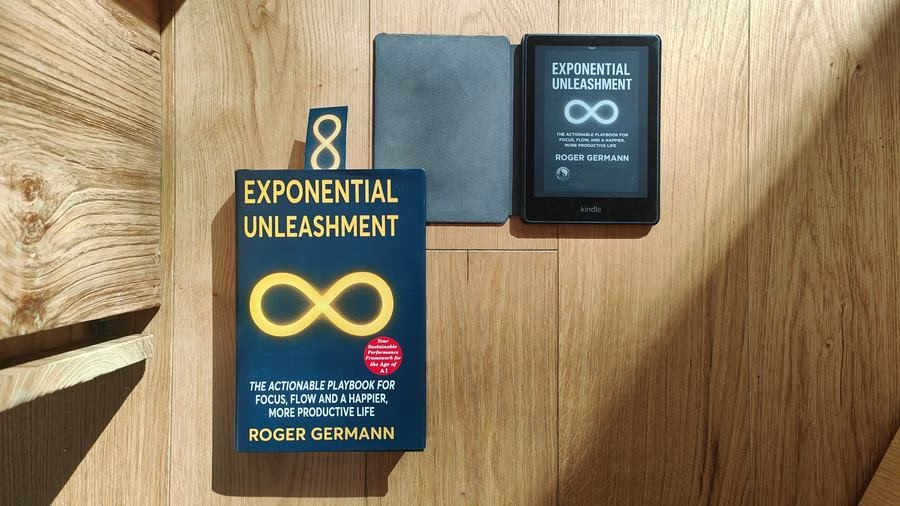
People spend years searching for better routines, stronger discipline, and greater productivity. Many try to force results through long hours and endless effort, only to feel mentally drained along the way. Roger Germann’s Exponential Unleashment: The Actionable Playbook for Focus, Flow, and a Happier, Healthier, More Productive Life challenges that entire mindset with a framework built around alignment, sustainability, and compounding progress.
The book offers readers a practical path toward clearer thinking, healthier changes, and lasting personal growth in a world that rarely slows down.
First Impressions of the Book’s Core Message
What immediately separates Exponential Unleashment from many self-development books is its structure. Roger Germann’s book presents a connected system where every chapter builds upon the previous one.
The foundation of the framework is surprisingly simple. Small improvements in daily life create ripple effects that influence everything else. Better sleep increases focus. Improved focus helps people enter flow states more naturally. Flow creates deeper engagement with work and relationships. Stronger relationships lower stress, which then improves sleep and emotional wellbeing. Over time, those gains begin multiplying.
Roger explains this process clearly and avoids overwhelming readers with unrealistic expectations. The emphasis stays on practical adjustments that fit into everyday life. That approach makes the book feel approachable for both professionals managing demanding careers and individuals simply looking for greater balance.

Throughout the chapters, the writing remains thoughtful and conversational. Scientific concepts are explained in a way that feels accessible without losing depth. Readers do not need a background in psychology or neuroscience to understand the ideas being discussed.
Exploring Focus, Flow, and Emotional Wellbeing
A major theme in the book is the relationship between performance and recovery. Roger repeatedly argues that people often damage their progress by relying too heavily on pressure and intensity. He refers to this as the “Performance Paradox,” where excessive effort actually reduces clarity, creativity, and long-term capability.
Instead of glorifying burnout, the book explores how sustainable performance develops through rhythm and structure. Roger encourages readers to create conditions that support concentration and flow rather than forcing productivity through stress.
The sections discussing flow states stand out because they connect science with practical application. Roger explains how the brain responds when attention becomes fully absorbed in meaningful activity. He also shares strategies that help readers reduce distractions and increase focus naturally.
Another compelling idea is the “Second Arrow Principle.” Drawing from both neuroscience and ancient wisdom, Roger examines how emotional suffering often grows from repeated mental reactions rather than the original problem itself. The discussion feels relevant in today’s fast-moving environment where stress and overstimulation have become common experiences.
The book also dedicates attention to physical and emotional foundations that influence daily performance. Sleep quality, breathing, movement, gut health, and relationships are treated as interconnected elements rather than separate wellness topics. Roger consistently reinforces the idea that every part of life affects the others.
This interconnected perspective gives the book depth and makes the framework feel realistic instead of overly simplified.
The Life Experiences That Shaped the Framework
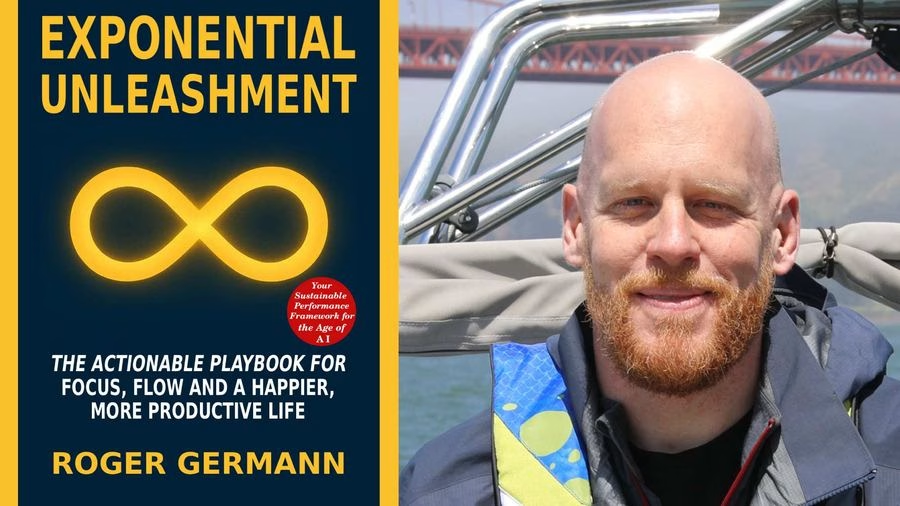
Roger Germann’s personal background plays a major role in the strength of the book. His ideas are rooted in decades of experience across industries including banking, hospitality, education, infrastructure, marketing, and events. He also spent eleven years leading an international company in Switzerland before significant post-pandemic changes altered his direction.
After the loss of his mother and the closing of his business, Roger spent more than three years traveling 111,000 kilometers (69,000 miles) across continents by camper and motorcycle. During those travels, he observed similar patterns everywhere he went. People were working harder than ever while becoming increasingly disconnected, distracted, and exhausted.
Those observations eventually became the foundation for Exponential Unleashment. Roger began identifying how fragmented attention, chronic stress, and constant pressure were limiting human potential. His response was not another productivity shortcut. Instead, he created a broader system designed around sustainable growth and long-term resilience.

His perspective on dyslexia also adds an interesting dimension to the book. Roger describes it as an advantage that helped him think in patterns and systems rather than isolated details. That mindset is reflected throughout the framework he presents.
About the Author
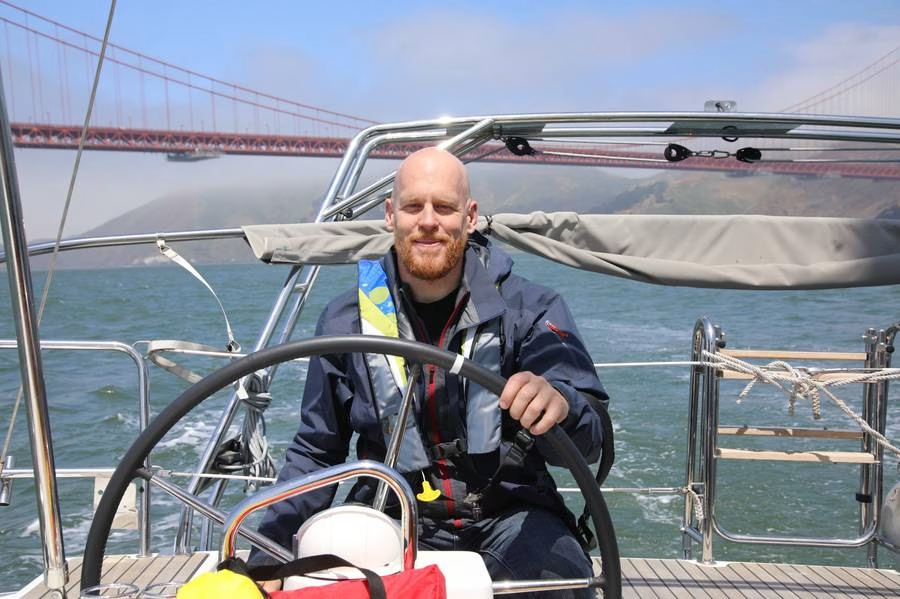
Roger Germann is an entrepreneur, speaker, and author who focuses on sustainable performance and systems thinking in the Age of AI. Fluent in six languages and experienced across multiple industries, he combines behavioral science, lived experience, and global observation into practical frameworks that help individuals build resilience, clarity, and long-term capability.
Final Reflections on the Book’s Impact
Exponential Unleashment delivers a thoughtful perspective on modern performance and wellbeing. Roger Germann encourages readers to stop chasing intensity and begin building systems that support lasting progress. His framework feels especially relevant in a time when many people are searching for healthier ways to work, think, and live.
For readers interested in focus, emotional balance, flow, and sustainable productivity, this book offers valuable insights that feel practical, grounded, and deeply human.
We had the privilege of interviewing the author. Here are excerpts from the interview:
Thank you so much for joining us today! Please introduce yourself and tell us what you do.
I’m Roger Germann, author of Exponential Unleashment. I spent three decades inside the Rat Race in hospitality, banking, events, marketing, and eleven years running an international company in Switzerland. I’m an entrepreneur by trade and, it turns out, an observer by temperament. These days, I write and speak about something I call sustainable performance: how people build real, lasting capability in a world that is accelerating faster than our biology was designed to handle. My work pulls together systems thinking, behavioral science, and an unusual set of lived experiences into one practical model. The short version: I help people stop confusing intensity with progress, and start building the kind of capacity that compounds.
Please tell us about your story.
My story is unusual.
After COVID, sea freight costs rose more than tenfold, and the structure that made the business viable simply stopped existing.
At the same time, I spent seven years partially caring for my mother, who had frontal dementia. That period taught me more about stress, human limitation, and what it means to show up than any business did.
So with the company dissolved and my mother gone, I left Switzerland and spent 1111 days traveling over 111,000 kilometers (69,000 miles) across continents by camper and motorcycle. It wasn’t an escape. It became an observation. Everywhere I went, across radically different cultures, I kept seeing the same pattern: enormous effort with no alignment, burnout dressed up as ambition, fractured attention, chronic stress, disconnected relationships. The world was speeding up, but people’s inner architecture wasn’t evolving to match.
Then came one night in Santiago de Compostela. I had a grill accident, and within moments, it was no longer a small fire. I nearly burned down the Holy City, and very nearly myself with it. Standing there afterwards, everything I’d been observing for three years collapsed into a single clear insight: high performers don’t fail from lack of effort. They fail because effort without architecture eventually burns the thing it was meant to build.
Exponential Unleashment is what came out of that. It’s not a collection of tactics. It’s the deeper system underneath sustainable performance, small, aligned shifts that compound into expanded capability, instead of more pressure applied to a structure that can’t hold it.
What are the strategies that helped you become successful in your journey?
I’d offer four, and they’re the same four the book is built on.
The first is architecture over intensity. For most of my life I believed the answer to any problem was more effort. It isn’t. A bridge survives a typhoon not because it pushes back harder but because its design distributes the load. People work the same way. The question is never “how hard can I push?” It’s “what structure am I pushing against, and will it hold?”
The second is patterns over sequences. I’m dyslexic, and for years I treated that as something to compensate for. I now see it as the single most useful thing about how I think. It forced my mind to work in systems and connections rather than isolated facts in a line. Where most people see separate problems, I tend to see one connected foundation. Start working with your mind, stop fighting it. Build on it.
The third is treating biology, emotion, and mental load as real inputs, not noise. Caring for my mother taught me this the hard way. Every performance system I’d ever encountered quietly assumed the human being was a fixed, reliable machine. We are not. We are biological organisms that sleep, recover, break down, and rebuild. The moment you design your life around that reality instead of against it, everything gets more sustainable.
The fourth is small aligned shifts, compounded patiently. The most powerful changes are almost embarrassingly small. They don’t feel impressive on any given day. But aligned and repeated, they compound, and compounding is the only force I know of that quietly outperforms raw willpower over a lifetime.
I’d add one honest caveat. I didn’t arrive at any of this through success. I arrived at it through a business closure, a parent’s illness, three years of displacement, and one night I’d rather not have lived through. The strategies are real. The path to them was not clean. I think readers deserve to know that.
Any message for our readers
We are entering an era, the Age of AI, where the world will keep accelerating whether or not we’re ready for it. You cannot out-hustle that curve. Nobody can. What you can do is build an inner architecture steady enough to stand inside the acceleration without being flattened by it.
So here is what I’d ask you to consider. The breakdowns you’re experiencing, the scattered focus, the sense that more effort produces less result, those are not personal failures. They are usually signs of a missing structure. And structure can be built. It’s built quietly, in small aligned shifts, long before the storm arrives. The best time to build it is in calm seasons, which means the best time is now.
You don’t need to become more intense. You need to become better designed. That’s a far kinder goal, and it’s the one that actually lasts.
Thank you so much, Roger, for giving us your precious time! We wish you all the best for your journey ahead!
Knowledge grows when shared. Please Pass it on!

Discover more from Paxjones
Subscribe to get the latest posts sent to your email.