

The new manager knows how to run a station, handle a difficult guest, and keep moving when the dinner rush arrives. Now they also have to guide everyone else through it. Clay David Laugier’s Coaching Playbook For Modern Times begins with that sudden change in responsibility and gives managers tools for the shifts that follow.
The Work Nobody Explained
A promotion can recognize years of good work while bringing an unfamiliar set of demands. The person who once solved problems with their own hands now has to help a team solve them together. They must explain standards, notice when someone needs support, and speak up when a problem keeps returning.
Clay knows the setting. His books are written for restaurant managers, kitchen leaders, shift supervisors, and retail operators whose days rarely follow a neat training plan. A conversation planned for a quiet afternoon may have to happen between orders. A new process has to make sense to employees working different schedules. The manager needs an approach they can use under those conditions.
The series also acknowledges how personal leadership can feel. Someone may hesitate to correct an employee they worked beside last month. They may inherit a team with established habits and little trust in its new manager. Clay addresses those moments directly, treating each one as a chance to build clearer expectations and a stronger working relationship.
From a Repeated Problem to a Better Routine
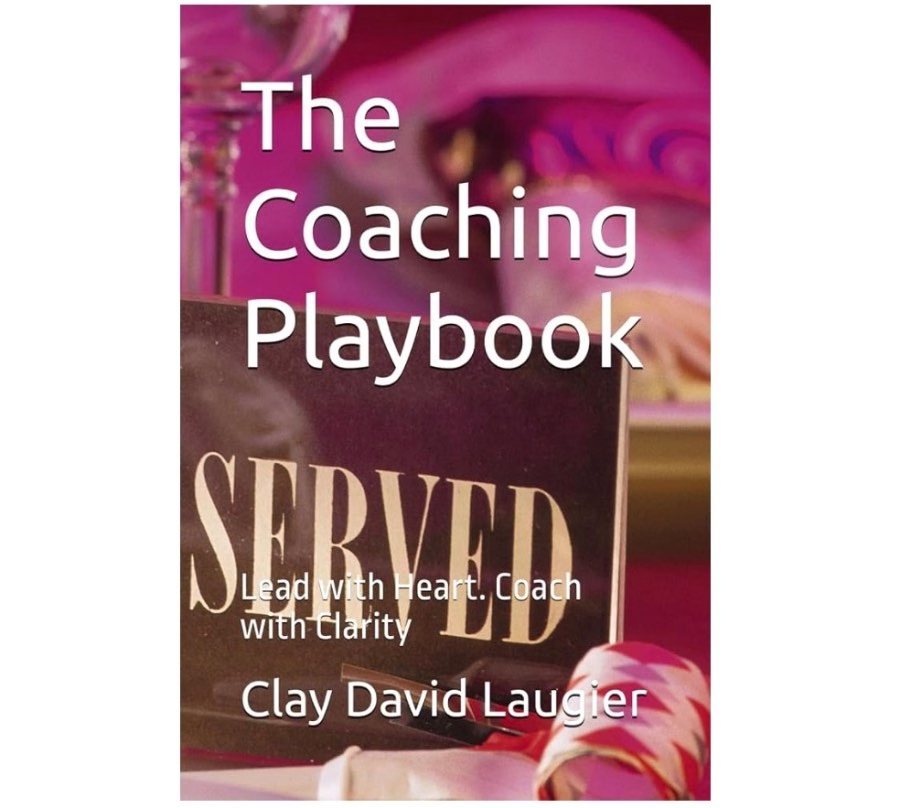
The first book, The Coaching Playbook: Lead with Heart. Coach with Clarity, gives managers a method for coaching people through change. Its Coaching Loop moves through five actions: Observe, Coach, Apply, Review, and Repeat. A manager begins with what they can see, works with the employee on a response, and returns to the conversation after the employee has tried it.
That return visit can be the difference between a promising talk and a lasting habit. On a busy team, yesterday’s guidance can disappear beneath today’s demands. Clay’s approach asks managers to keep checking what happens on the floor and to make coaching part of the regular rhythm of work.
For problems that keep resurfacing, he introduces the S.H.I.F.T. Sequence: See it, Hear it, Install it, Frame it, and Transfer it. The framework helps an operator look into a breakdown, put a response in place, and carry it across shifts. It speaks to the manager who’s tired of fixing the same issue whenever a different person takes charge.
Set The Tone: What to Say, and How to Lead, When It Matters Most, the second book, concentrates on what managers say while using that judgment. Its twelve chapters cover recognizable situations, including the pre-shift meeting, a difficult correction, and the first thirty days with a team the manager did not hire. Clay provides scripts and tools readers can bring into their own workplaces.
A pre-shift talk, for example, has only a brief window to prepare people for the hours ahead. The right words can make priorities clear and help employees understand where they’re needed. In a private correction, careful language can keep the discussion focused on the behavior and the next step. These are small moments with consequences that carry through the shift.

About Author Clay David Laugier
Clay has spent more than twenty years working in food service, hospitality, and retail, including time on the floor and in the general manager’s chair. Based in New York’s Hudson Valley, he writes as Clay David Laugier and works with operators through Clay Laugier Ventures and Seeded Concepts.
His coaching focuses on making practical knowledge teachable. Experienced operators often recognize a guest’s needs or a team’s trouble before anyone else does. Clay helps managers turn that awareness into standards and coaching practices others can learn. He also cofounded a community café and business incubator in Kingston, New York, built around employment, training, and local reinvestment.

A More Confident Way to Lead
Managers cannot predict every challenge waiting on the next shift. They can prepare for the conversations and decisions that come up again and again. Available in Kindle and paperback editions on Amazon, Coaching Playbook For Modern Times gives them a place to begin: a method for helping people improve, language for the moments that matter, and the confidence to keep practicing.

We had the privilege of interviewing the author. Here are excerpts from the interview:
Thank you so much for joining us today! Please introduce yourself and tell us what you do.
I’m Clay Laugier. I’m a hospitality and retail coach, an author, and after more than twenty years on the floor, still very much a floor operator myself. I write and publish under Clay David Laugier and run my coaching and content work under Clay Laugier Ventures out of the Hudson Valley in New York. What I do is simple to describe and hard to do well. I coach managers and operators to turn ordinary shifts into places where people actually want to work, and guests actually want to come back. I take the coaching, the systems, and the guest read that most great operators only carry around in their heads, and I make them teachable, so a team can run on a standard instead of running on whoever happens to be working that day. My brand mark is Bigfoot, and that is not an accident. I’ve built a whole career on paying attention to the people and the details everyone else walks right past. Lead with heart, coach with clarity. That’s the whole thing.
Please tell us about your journey.
On the surface, my story looks like a lot of hospitality careers. I started at the ground level and spent more than two decades learning the business the slow way, one shift at a time, across food service and retail. What changed everything was a shift in how I saw the problem. For years I watched good people get blamed for what were really broken systems. Turnover got called a hiring problem when it was almost always a coaching problem. Bad service got called a bad attitude when it was really a missing standard. So I stopped shaming staff and started building systems, and those systems became a coaching philosophy, and that philosophy became two books, Set the Tone and The Coaching Playbook: Lead with Heart. Coach with Clarity. I wrote both of them while still working floors, on purpose, because I never wanted to be one more person teaching leadership from a distance. On the writing side, coaching was never the only thing on my desk. I’m a Hudson Valley native and a lifelong storyteller, and I’m at work on a fiction series rooted in Indigenous and American legends, the old stories this country was built on top of and then mostly forgot. It runs on the same instinct as my coaching. Pay attention to what’s been overlooked, take it seriously, and hand it back to people in a form they can actually use. Bigfoot, folklore, and floor coaching are closer cousins than they look.
What are the strategies that helped you become successful in your journey?
On staying close to the work. The best decision I ever made was refusing to leave the floor. Everything I coach comes from lived experience instead of a slide deck, and operators can feel that difference in about thirty seconds. That is the whole reason my stuff lands. I’m not teaching from a distance; I’m teaching from inside the shift. On building systems instead of leaning on effort, I run a simple loop with everyone I coach: observe, coach, apply, review, repeat. When the system carries the standard, you stop depending on heroics, and you stop burning out your best people to cover for a process nobody ever actually built. Managers hire me because they’re exhausted, and what they usually need isn’t more effort. It’s a system. On treating hospitality as a skill and not a personality trait, I break the guest read down into a few questions anyone on the team can learn. Warmth becomes coachable. Memorable, generous hospitality stops being something you either have, or you don’t, and starts being something you can install in a new hire inside a week. And on integrity, I never put a claim in front of an operator that I can’t personally stand behind. In an industry full of noise and guru nonsense, being the person who only says what’s actually true turns out to be the strongest sales pitch there is.
Any message for our readers
On this one, I’ll keep it short and mean every word. Your team isn’t broken. Your system is. Stop grading your people against a standard you never actually taught them, and start building the system that makes the standard obvious. Lead with heart, coach with clarity, and stay close enough to the work that your team knows you’d never ask them to do something you wouldn’t do yourself. If that hit home, here’s where to find me. Both of my books, Set the Tone and The Coaching Playbook: Lead with Heart. Coach with Clarity, are on Amazon under Clay David Laugier. If you want the system built with you instead of just read about, I coach operators and managers one on one, and you can reach me at claylaugier.com. And if you’re the kind of reader who loves a good American legend, keep an eye out for my fiction. Same eye for the overlooked, pointed at the old stories instead of the schedule. Hashtags
Thank you so much, Clay, for giving us your precious time! We wish you all the best for your journey ahead!
Clay David Laugier is a hospitality and retail coach and the author of Set the Tone and The Coaching Playbook: Lead with Heart. Coach with Clarity, both on Amazon. He coaches operators and managers at claylaugier.com and is at work on a fiction series drawn from Indigenous and American legends.
Knowledge grows when shared. Please Pass it on!

Discover more from Paxjones
Subscribe to get the latest posts sent to your email.