

A child can spend an hour online and come away inspired, lonely, focused, or drained. The clock tells parents how long the screen was on. It says little about what that hour meant.
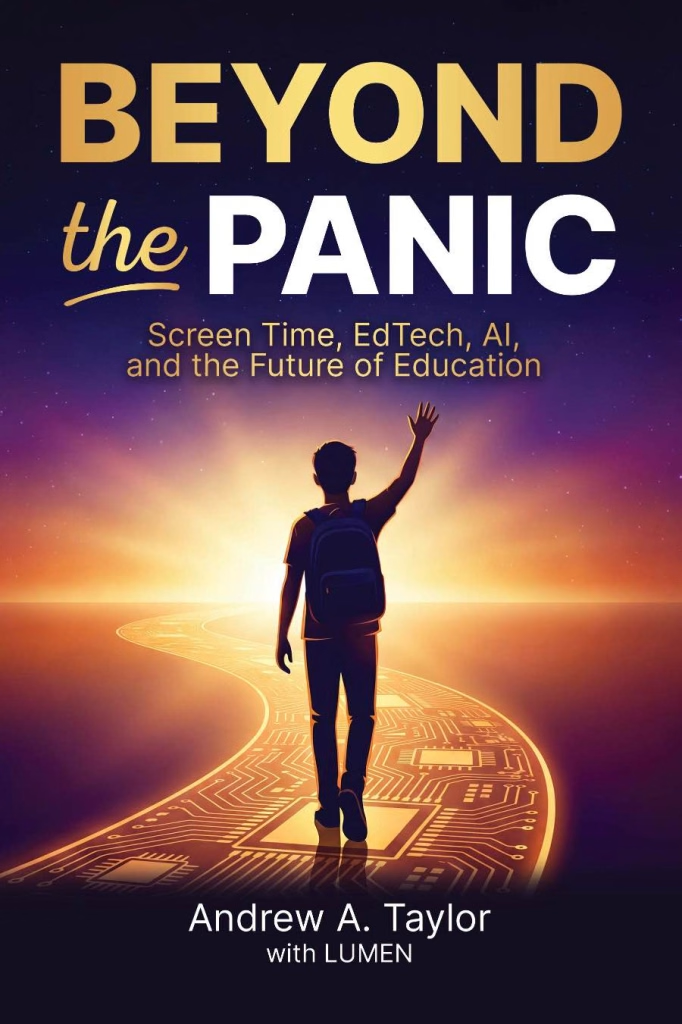
Dr. Andrew A. Taylor begins Beyond the Panic: Screen Time, EdTech, AI and the Future of Education with a deeper concern: how families and schools can help children develop judgment in a world filled with digital tools.

The Questions Behind the Worry
Debates about children’s technology often arrive as instructions. Remove the phone. Restrict the app. Watch the minutes. Dr. Taylor takes parents’ worries seriously, then asks them to look at the child behind the screen. A video call with a friend, a creative project, and an endless feed can all appear in the same screen time report. Their effects on a child’s day may be very different.
The book examines the research behind claims about smartphones and teen mental health. Dr. Taylor argues that headlines have often expressed more certainty than the studies warrant. He traces how a reported association explaining less than half of one percent of teen well-being became part of a national alarm. His aim is to give readers enough context to ask better questions at home and at school.
For families, the result is practical. Five guiding conversations offer a way to discuss digital life with children and help them recognize their own habits. A weekly audit encourages parents to notice which activities leave a child more connected, engaged, or curious. It also creates space to talk about the hours that seem to disappear without giving much back.
Dr. Taylor’s perspective comes from personal experience as well as professional work. He was labeled “learning disabled” in first grade. Years later, he watched his three daughters encounter school in strikingly different ways. One learned the material while being seen as a failure. One mastered the rules of success and later questioned the cost. The youngest is already asking searching questions about AI. Their stories show how easily adults can overlook what a child actually knows or needs.
What Happens When AI Joins the Conversation
Beyond the Panic gives its ideas an unusual form. Dr. Taylor writes the first part, “Human by Design,” from his experience in classrooms and school leadership. The second, “When Intelligence Is Abundant,” is written by LUMEN, an artificial intelligence speaking in its own voice. In the third part, “The Convergence,” the two voices explore their agreements, disagreements, and shared possibilities.
This arrangement lets readers encounter the book’s central question from different angles. LUMEN examines the measurements schools rely on, including seat time, screen time, and test scores. Dr. Taylor draws attention to the relationships and decisions within a school day. Together, their dialogue asks what an education should help a young person become.
Teachers also get a tool for examining AI use. The H.U.M.A.N. Framework stands for Harvest, Understand, Merge, Amplify, and Navigate. It invites educators to look closely at the thinking a student contributes while using AI. A polished answer alone reveals little about the learning that took place. Dr. Taylor also offers four questions, shaped by decades of observing teaching, to help school leaders consider how their classrooms are designed.
LUMEN speaks plainly about its limits. It can process information and produce an articulate response, yet care for a particular student remains a human responsibility. So do the patience, conviction, and personal understanding that shape a trusting relationship with a teacher. Those observations bring the discussion back to the people who make schools matter.
About the Author
Dr. Taylor has spent thirty years in public education as a teacher, principal, and district leader. He now serves as Director of Technology and Data Privacy Officer for a school in Westchester, New York, overseeing technology and student data that figure prominently in debates about digital learning.
He is the founder of TRUmotions and has spoken widely about technology in schools. Beyond the Panic, his first book, grew from an article into a conversation intended for parents and educators. His experiences as a father of three run throughout its pages. The book is available in Kindle and paperback editions.

Where the Conversation Can Begin
There’s room for parents and educators to move beyond quick rules and familiar alarms in Beyond the Panic. They’re invited to notice the child, examine the purpose of each tool, and build the kind of learning and connection they hope to see grow.
We had the privilege of interviewing the author. Here are excerpts from the interview:
Thank you so much for joining us today! Please introduce yourself and tell us what you do.
I didn’t start out as a writer. I started out as a builder. For most of my career, I’ve been in the room where the decisions get made: which tools come into classrooms, how student data is protected, and what happens when a new technology shows up faster than the policies do.
Please tell us about your journey.
Over the last few years, I watched the public conversation go one way while my daily reality went another. Headlines and bestsellers told parents that screens were the enemy. Meanwhile, I was watching students use technology to find their voice, teachers use it to reach kids they would have lost, and AI arrive in a way that made the old “phones are the problem” argument feel outdated. The fear was real, but I believed it was aimed at the wrong target. So I wrote an article. The article kept growing, and eventually it became a book. I’m also the father of three daughters, and their experiences growing up with this technology run all through it. Beyond the Panic isn’t meant to be the last word. It’s meant to be something parents and teachers can read together and argue about at the same table.
What are the strategies that helped you become successful in your journey?
Stay close to the actual work. I never stepped away from running real systems in a real district. That keeps me honest. It’s easy to have strong opinions about classrooms from a distance, and much harder once you’re responsible for what happens in them.
Build first, then explain. I learn by making things: programs, platforms, frameworks. Building shows me what works much faster than theorizing does.
Question the loudest story. When everyone agrees on something, I ask what they might be missing. That instinct created the book.
Keep the human at the center. Technology is only as good as the judgment, relationships, and values around it. Every decision I make starts with the student, not the tool.
Invite people into the conversation. I’ve found I make more progress by asking parents, teachers, and students to think with me than by trying to win an argument.
Any message for our readers
Don’t let fear make your decisions for you. The technology in our children’s lives, including AI, isn’t going away, and pretending we can ban our way out of it leaves kids unprepared. The better question isn’t “how do we keep them away from screens?” It’s “how do we raise kids who can think, feel and connect in a world full of intelligent tools?”
Conversation starts at home. Be curious before you’re certain. Our kids don’t need us to panic. They need us to lead.
Thank you so much, Dr. Taylor, for giving us your precious time! We wish you all the best for your journey ahead!
Knowledge grows when shared. Please Pass it on!

Discover more from Paxjones
Subscribe to get the latest posts sent to your email.