

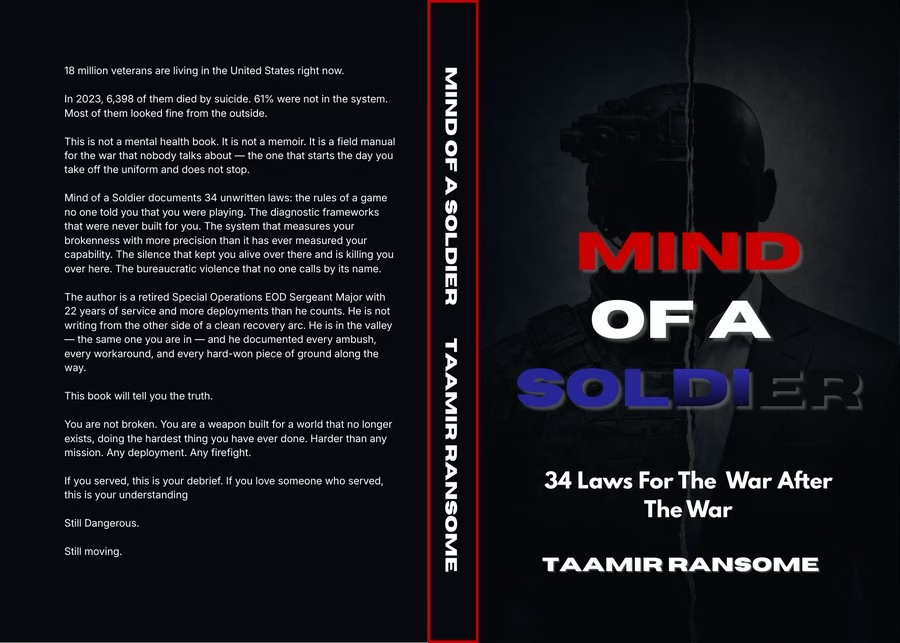
The moment a soldier returns home is often framed as a finish line. For many, it feels more like stepping into unfamiliar territory without a map. Mind of a Soldier: 34 Laws for the War After the War by Taamir Ransome captures that exact shift, offering a grounded exploration of what life looks like once the mission ends but the mindset remains.
The moment a soldier returns home is often framed as a finish line. For many, it feels more like stepping into unfamiliar territory without a map. Taamir Ransome captures that exact shift in his book, offering a grounded exploration of what life looks like once the mission ends but the mindset remains.
First Impressions
Taamir Ransome presents his book with a clear sense of direction. It is not positioned as a personal story filled with reflection, nor does it follow the typical format of motivational writing. Instead, it operates as a structured guide built on experience, discipline, and observation.
The concept of “laws” gives the book a distinct rhythm. Each one addresses a specific reality veterans face after leaving active duty. These insights feel sharp and intentional, reflecting the mindset of someone trained to analyze risk and act with precision. Taamir keeps the language straightforward, allowing the message to carry weight without unnecessary complexity.
From the beginning, readers can sense that this work is designed to confront rather than comfort. It challenges assumptions and brings attention to aspects of post-service life that are often overlooked.
Breaking Down the Gaps
A key strength of the book lies in its examination of systemic shortcomings. Taamir highlights how support systems, though well-intentioned, often fail to match the realities of long-term military experience. Many frameworks were created with limited scenarios in mind, leaving career service members navigating solutions that do not fully apply to them.
He discusses how diagnoses and treatments tend to focus on isolated incidents, while many veterans deal with layered experiences built over years. This disconnect creates frustration and can lead to a sense of being misunderstood. Taamir supports these points with both data and lived experience, giving readers a clearer picture of where things fall short.
Another important element is how society views veterans. Taamir explains that they are often placed into simplified categories, which do not reflect the full range of their experiences. These labels create barriers instead of understanding, shaping interactions in ways that feel distant rather than supportive.
Life Without a Defined Mission
One of the most impactful themes in Mind of a Soldier revolves around identity. Military life provides structure, clarity, and purpose. Every action serves a defined goal. Once that structure is gone, many veterans face a sense of uncertainty that is difficult to articulate.
Taamir frames this transition as a process of adjustment rather than loss. The skills developed during service remain active. Awareness stays heightened. Decision-making patterns continue to operate at a level shaped by high-pressure environments. When placed into everyday civilian life, these traits can feel out of sync.
He explores how this mismatch affects different aspects of life. Sleep becomes irregular. Relationships may feel strained. Even simple routines can take on a different meaning. Taamir explains that these changes are not signs of failure. They are the result of a system that trained individuals for one environment without preparing them for another.
Silence plays a significant role in this phase. Without constant movement or clear objectives, there is room for reflection. Taamir describes this silence as one of the most challenging elements to face. It is where many internal struggles begin to surface.
He also touches on everyday interactions. Expressions of gratitude, while appreciated, often do not lead to meaningful conversations. Taamir suggests that deeper understanding requires engagement that goes beyond surface-level acknowledgment.
Reaching Different Audiences
The book does not limit itself to one group of readers. Veterans may find a sense of recognition in its pages, seeing their experiences explained with clarity. It provides language for thoughts and feelings that are often difficult to express.
Families and partners benefit from the insight as well. Taamir offers a perspective that helps explain behavioral changes without assigning blame. This understanding can strengthen communication and create space for more meaningful support.
For civilians, the book serves as a guide to understanding a world that is often misunderstood. Taamir does not rely on dramatic storytelling. Instead, he presents information in a way that encourages reflection and awareness. Readers come away with a more nuanced view of what life after service can look like.
What makes the book stand out is the author’s position within the journey. Taamir is not presenting a finished story. He is still navigating the process, which adds authenticity to his perspective. It reinforces the idea that adjustment is ongoing and shaped by daily experiences.
About the Author
Taamir Ransome is a retired Special Operations EOD Sergeant Major who built a career around high-risk operations and critical decision-making. As the first Black Tier One EOD operator in U.S. history, he played a significant role in some of the most demanding missions across six continents. His service includes time with the 82nd Airborne in Iraq and the 75th Ranger Regiment in Afghanistan, along with various assignments within the National Mission Force.
After transitioning from military life, Taamir pursued academic growth, earning dual master’s degrees in data science and data analytics with a focus on artificial intelligence. He now works in veteran advocacy and technology, developing systems aimed at improving support for those who have served. His efforts reflect a commitment to addressing challenges he has experienced personally.
Why It Matters
Mind of a Soldier provides a clear and honest look at a phase of life that is rarely discussed in depth. It brings attention to the realities veterans face while offering a structured way to understand them. Taamir’s work stands as a valuable resource for anyone seeking insight into the ongoing journey that begins after service ends.
We had the privilege of interviewing the author. Here are excerpts from the interview:
Thank you so much for joining us today! Please introduce yourself and tell us what you do.
Taamir Ransome. Retired Army Special Operations Explosive Ordnance Disposal (EOD) Operator or Bomb Squad. The job where you walk toward the thing everyone else is running from. I was the first Black Tier 1 EOD operator in history and, at one point, the only Black EOD Sergeant Major in the world. Operated on 6 continents. Dual master’s degrees in data science and data analytics, specializing in AI. Author of Mind of a Soldier: 34 Laws for the War After the War, currently trending on Amazon, off pure word of mouth.
Please tell us about your journey.
The military gave me a skeleton, and I built my entire life around it. Then the uniform came off, and I had to answer a question nobody trained me for: Who am I when I’m no longer needed?
On paper, I did everything right. Degrees. Career in tech. Employed immediately. Behind the paper, I was running on caffeine and bourbon, not sleeping, ignoring calls from people who loved me because answering required a version of myself I didn’t have fuel for. I was “fine” for years. Fine is the most dangerous word in a veteran’s vocabulary.
I started writing down the things nobody was saying out loud. 34 laws. The unwritten rules that cost people their marriages, their health, their minds. A field manual for the war nobody sees. I’m not writing from the finish line. I’m still in it.
What are the strategies that helped you become successful in your journey?
I stopped waiting for the system to save me and went to find what actually works. I stayed dangerous, applied every skill the military built into me to new problems. I stopped performing recovery for an audience and wrote what was true instead of what was comfortable. And I leaned on real people who’ve been where I’ve been.
Any message for our readers
Veterans: you’re not broken. The system is. This book won’t fix you because you don’t need fixing. It’ll tell you the truth.
Civilians: if someone you love came home different or if you want to understand the veteran who may be your neighbor, in your congregation, or your co-worker, this is your translation guide. Sympathy is a wall. Understanding is a door.
Leave a review if you’ve read it. That’s how the next veteran finds it at 2 AM. If you haven’t, stop waiting.
Thank you so much, Taamir, for giving us your precious time! We wish you all the best for your journey ahead!
Knowledge grows when shared. Please Pass it on!

Discover more from Paxjones
Subscribe to get the latest posts sent to your email.