
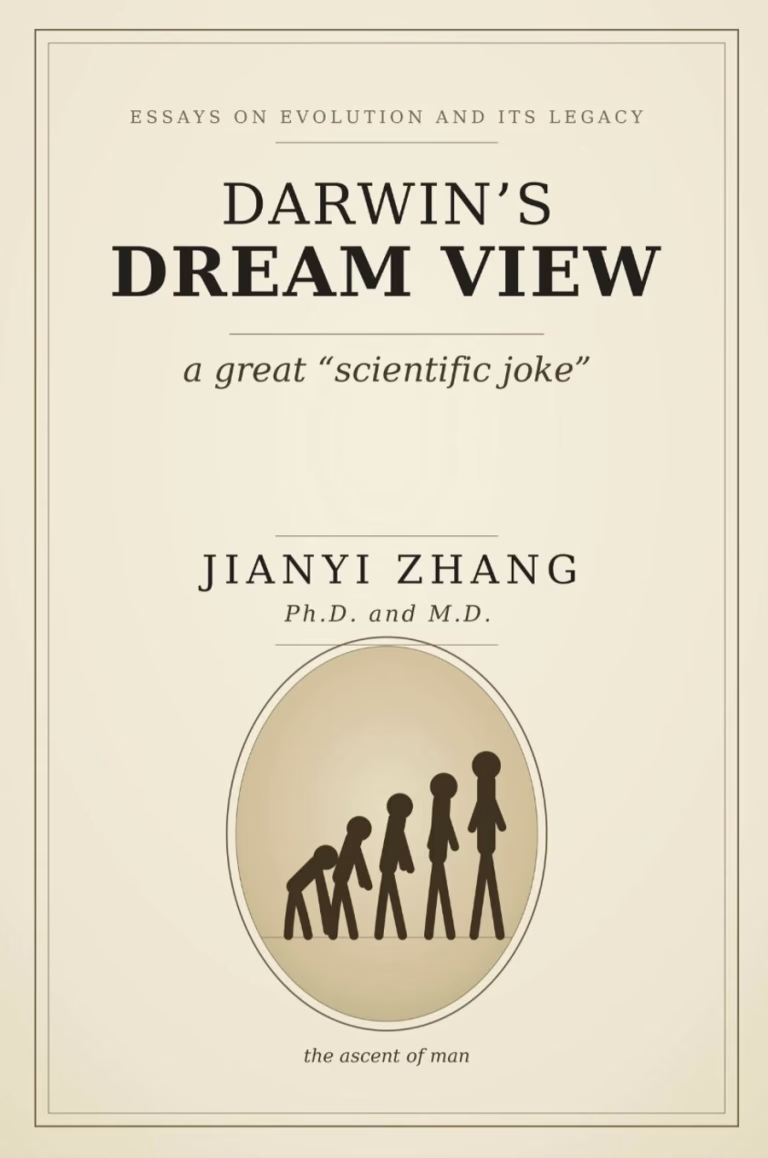
Scientific progress depends on curiosity, evidence, and a willingness to revisit established explanations. In DARWIN’S Dream View: A Great “Scientific” Joke, Jianyi Zhang brings that questioning spirit to one of biology’s most influential theories.
Through 57 focused essays, Zhang examines Darwinian evolution, modern evolutionary thought, and the wider historical influence of ideas associated with competition and the struggle for existence.
Examining the Different Layers of Evolution
Published in 1859, Charles Darwin’s theory of evolution by natural selection transformed the study of living organisms. Its influence soon extended into philosophy, politics, sociology, and discussions about human development. Zhang argues that such a deeply rooted theory deserves sustained methodological scrutiny.
The book separates biological evolution into three layers. The first is macroevolution, described through common descent. The second is microevolution, which involves heritable variation within populations. The third concerns Darwin’s proposed mechanism through which competition for limited resources gradually contributes to the formation of reproductively isolated species.
Zhang accepts biological change, variation, heredity, adaptation, and common descent as meaningful parts of evolutionary science. His central concern is the mechanism proposed to connect changes within a population to the emergence of new species. According to the book, research has yet to directly document a population undergoing sustained resource scarcity and subsequently dividing into reproductively isolated species within observable timeframes.
This distinction gives the discussion a clear focus. Zhang’s critique centers on the evidentiary status of the Darwinian engine and the standards used to evaluate its claims. Readers are encouraged to separate broad acceptance of evolution from agreement with every proposed explanation of how evolutionary change occurs.
Questioning the Modern Synthesis and Scientific Testability
Another major subject is the Modern Synthesis, which combined Darwinian natural selection with Mendelian genetics, mutation, and other discoveries. Zhang asks which elements of Darwin’s original framework were retained, modified, or abandoned as evolutionary biology developed.
He describes the resulting framework as a “laundry-list” theory because it has expanded to include numerous mechanisms over time. In his assessment, the theory’s meaning can shift depending on the challenge being discussed. Its central claim may be presented as adaptation in one context and extended to large-scale speciation in another.
The book evaluates this issue through philosopher Karl Popper’s emphasis on falsifiability. A scientific theory should create conditions under which evidence could potentially show it to be wrong. Zhang argues that evolutionary explanations sometimes absorb conflicting findings without clearly identifying what evidence would disprove their central mechanism.
Across the essays, he considers familiar subjects such as “survival of the fittest,” ring species, genetic drift, mutation, reproductive isolation, and competition. His writing aims to make these technical discussions accessible to readers who may lack specialized training. Each chapter concentrates on a particular question, allowing the larger argument to develop in manageable stages.
Exploring the Historical Influence of Competition
Zhang also turns toward the social history connected with Darwin’s “struggle for existence.” Rooted partly in Malthusian ideas about population pressure and limited resources, this concept later entered political and social arguments far beyond biology.
The book traces links among competitive interpretations of nature, Social Darwinism, eugenics, racial ideology, and the worldview that contributed to atrocities in the twentieth century. Zhang believes mainstream discussions often give insufficient attention to this history. His essays call for a fuller examination of how scientific language can be adopted, transformed, and used within harmful political systems.
This section adds a moral dimension to the scientific discussion. It asks readers to consider how influential ideas travel beyond their original disciplines and acquire new meanings. Zhang treats historical accountability as part of responsible intellectual inquiry.
About the Author
Jianyi Zhang is a physician practicing in the United States who also holds a Ph.D. in molecular biochemistry. His professional background gives him experience in both clinical reasoning and scientific research.
His interests include evolutionary theory, herbal chemistry, and the treatment of Alzheimer’s disease. In this book, he applies his medical and biochemical training to questions about evidence, causation, scientific language, and the development of major theories.
A Thought-Provoking Invitation to Reconsider Familiar Ideas
DARWIN’S Dream View: A Great “Scientific” Joke presents a challenging perspective on a subject many readers may consider settled. Its accessible style helps translate complicated scientific and philosophical concerns into questions suitable for a wider audience.
Readers may agree with some arguments and dispute others, yet the book offers substantial material for reflection and conversation. Zhang ultimately invites people to approach science with active curiosity, careful reasoning, and the confidence to ask difficult questions.
Knowledge grows when shared. Please Pass it on!

Discover more from Paxjones
Subscribe to get the latest posts sent to your email.