

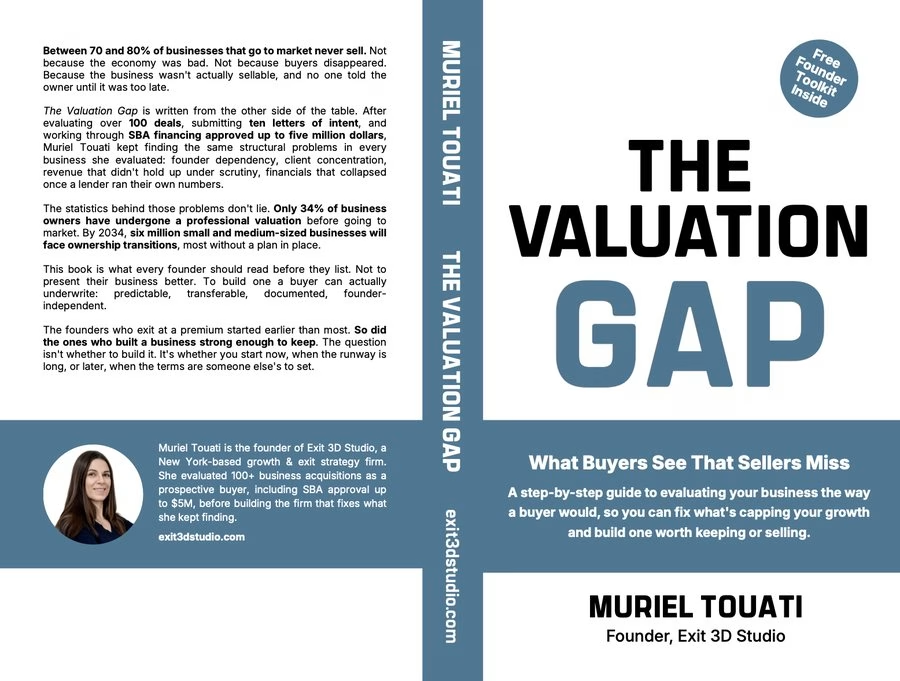
Many business owners build their companies with passion, instinct, and years of personal effort. They win clients, manage teams, solve problems, and assume that steady revenue will eventually lead to a strong exit. The Valuation Gap: What Buyers See That Sellers Miss by Muriel Touati challenges that assumption with a clear message: buyers value businesses differently than founders do.
The book gives service-business owners a practical look at valuation from the buyer’s side of the table.
What Makes a Business Hard to Sell
The book focuses on a problem many founders discover too late. A company may look healthy from the inside while still appearing risky to buyers and lenders. Revenue can be strong, yet the business may depend too much on the founder, a few large clients, or unclear processes.
Muriel explains that the valuation gap is usually built long before a company goes to market. It comes from decisions around sales, operations, positioning, documentation, and customer mix. These choices affect whether a buyer sees a scalable asset or a fragile operation.
Her perspective comes from real acquisition experience. After reviewing more than one hundred deals, studying data rooms, normalizing financials, and pursuing SBA-backed opportunities, Muriel saw the same issues appear again and again. That experience shaped the book’s central idea: founders need to understand what buyers underwrite before they expect premium offers.
The Signals Buyers Trust
Buyers do not simply pay for ambition. They pay for evidence. They want proof that the business can keep performing after the founder steps back.
Predictable Revenue
Consistent revenue is more powerful than short-term spikes. Buyers look for repeatable demand, diversified client relationships, and income streams that can be modeled with confidence.
Reduced Founder Dependency
If the founder is required for every sale, every client relationship, and every major decision, the business carries more risk. Strong systems, documented workflows, and capable teams can help improve buyer confidence.
Clear Market Position
A company’s website, messaging, reputation, and digital footprint all shape early impressions. Muriel shows why market perception matters before a buyer opens the spreadsheet.

About the Author
Muriel Touati is the founder of Exit 3D Studio, a New York-based growth and exit strategy firm helping founder-led service businesses build toward stronger valuations.
Her background combines digital marketing, acquisition analysis, and buyer-led strategy. Before founding Exit 3D Studio, Muriel built L’Accélérateur LinkedIn, a training and coaching program for independent consultants. Today, she helps founders improve revenue quality, reduce structural weaknesses, and build businesses that can grow with less daily dependence on the owner.
Originally from Nice, France, Muriel lives in Manhattan with her son and remains active among entrepreneurs, operators, and investors in New York.
Final Takeaway
The Valuation Gap is more than an exit-planning book. It is a guide for building a stronger business today.
For founders who want to grow, keep, or eventually sell their company for more, Muriel offers a practical reminder: the work that improves valuation also improves the business itself.
We had the privilege of interviewing the author. Here are excerpts from the interview:
Thank you so much for joining us today! Please introduce yourself and tell us what you do.
I’m Muriel Touati, founder of Exit 3D Studio in New York and author of The Valuation Gap: What Buyers See That Sellers Miss, which comes out July 27.
I help founder-led B2B service businesses — roughly $100K to $5M+ in revenue — build revenue that’s predictable, scalable, and transferable, so the company gets stronger and easier to step back from. Most of my clients aren’t trying to sell anytime soon. They just want a business that doesn’t depend entirely on them showing up every day.
What makes my approach different is that I look at growth from both sides of the table. After years as an entrepreneur in digital marketing, I spent 2025 on the buy side — actually trying to acquire a company myself. That experience changed how I see everything, because I stopped looking at a business the way a marketer does and started looking at it the way a buyer and a lender do. The same things that make a business attractive to a buyer are the same things that make it stronger and more enjoyable to own. That’s the whole idea behind what I do.
Please tell us about your journey.
I came to New York about four years ago and, for a while, kept running my business with French clients from here. At some point I wanted something rooted in the US, and I heard about a path I hadn’t seriously considered before: instead of building another company from zero, I could buy one.
So I went all in. I joined a community of acquisition entrepreneurs and learned the craft from the inside — deal sourcing, deal structuring, deal-making. Then I started doing it for real: evaluated more than one hundred deals, I got SBA-approved up to $5 million, and I submitted somewhere between ten and twelve letters of intent. I even had an offer accepted.
And then I walked away from it.
The deal that taught me the most was a marketing agency listed at $3.7 million. The broker presented it as a recurring-revenue business. But when I ran the numbers month by month, client by client, logo churn was running at 30 to 40%. The revenue wasn’t compounding — it was being replaced. Every month, new clients were coming in just to cover the ones walking out the door. The LOI was signed, the bank was with me, financing was in process. Then I withdrew, because once I underwrote what was actually there, a business presented at $3.7 million was worth closer to $600,000.
That gap — between what was presented and what was real — is exactly where the book gets its name. And it was never a one-off. Deal after deal, I kept finding the same four structural problems:
Revenue quality — income that swings and can’t be forecast, with no recurring or repeatable base underneath it. It’s the first thing a buyer stress-tests.
Customer concentration — too much revenue riding on two or three accounts. One client representing 40% of revenue isn’t a relationship; it’s a liability, and a buyer prices that risk before you even know it’s being calculated.
Founder dependency — the business is the founder. Take them out for three weeks and it stalls. That alone can cut a company’s value by half.
No real acquisition system — nothing that brings in business on its own. Growth runs on referrals and the founder’s personal network, with no engine and no digital assets that prove the company can win work without them.
Most founders never see these gaps, because no one ever shows them what a buyer sees. I’d lived a few of them in my own business, so I wasn’t judging from the outside. I wrote the book I wish someone had handed me years earlier.
What are the strategies that helped you become successful in your journey?
The single most useful shift is learning to look at your business the way a buyer does — not because you want to sell, but because that lens exposes everything that’s quietly broken while you still have time to fix it. Everything else follows from closing those four gaps on purpose:
Make revenue boring. Predictable, recurring, repeatable. The goal is income you can forecast, not income you have to pray for.
Spread the risk. Diversify the client base so no single account can take you down. Concentration feels like loyalty; to a buyer it reads as fragility.
Get yourself out of the center. Document the work, build the systems, hand off the relationships. If the business can’t run without you for 90 days, that’s the first thing to fix — and it’s the change that improves your daily life immediately.
Build an acquisition engine that isn’t you. A presence that brings in business without the founder personally chasing every referral.
That last one is where I’ve put most of my own energy. I took the program I’d spent years refining — LinkedIn profile, content strategy, content production, network development, prospecting — and rebuilt it as a fully done-for-you service, so a founder gets the acquisition engine without having to become a full-time marketer or stay dependent on ad spend and referrals. It’s becoming the core of a broader done-for-you growth offer that layers email and other channels on top of it.
If you’re reading this and you’re not sure where your own business stands across those four dimensions, that’s exactly what a free Business Growth Diagnostic is for — it maps your gaps through a buyer’s lens and tells you what to fix first. It’s the same diagnostic I’d run before underwriting a deal, pointed at your business instead.
And underneath all of it, one discipline: treat your numbers as if someone is going to challenge them, because eventually someone will — a buyer, a lender, or just reality. Clean, defensible reporting doesn’t only make a company sellable. It makes it well-run.
Any message for our readers
Build something that could run without you — not because you want out, but because that’s exactly what makes it worth running today. The work that makes a business sellable is the same work that makes it a better business to own. The best version of your company and the most valuable version are the same company. You don’t have to choose between them, and you shouldn’t wait for an exit to start.
The Valuation Gap is out July 27 at exit3dstudio.com/the-valuation-gap. You can learn more about my work — and book that free diagnostic — at exit3dstudio.com, and I go deeper on all of this on my YouTube channel, Exit 3D Insights (@exit3dinsights).
Thank you so much, Muriel Touati, for giving us your precious time! We wish you all the best for your journey ahead!
Knowledge grows when shared. Please Pass it on!

Discover more from Paxjones
Subscribe to get the latest posts sent to your email.