
A steady paycheck can provide comfort. A growing bank balance can create confidence. Yet the deeper question of financial freedom often comes down to something less visible: how much control do people have over the choices available to them?
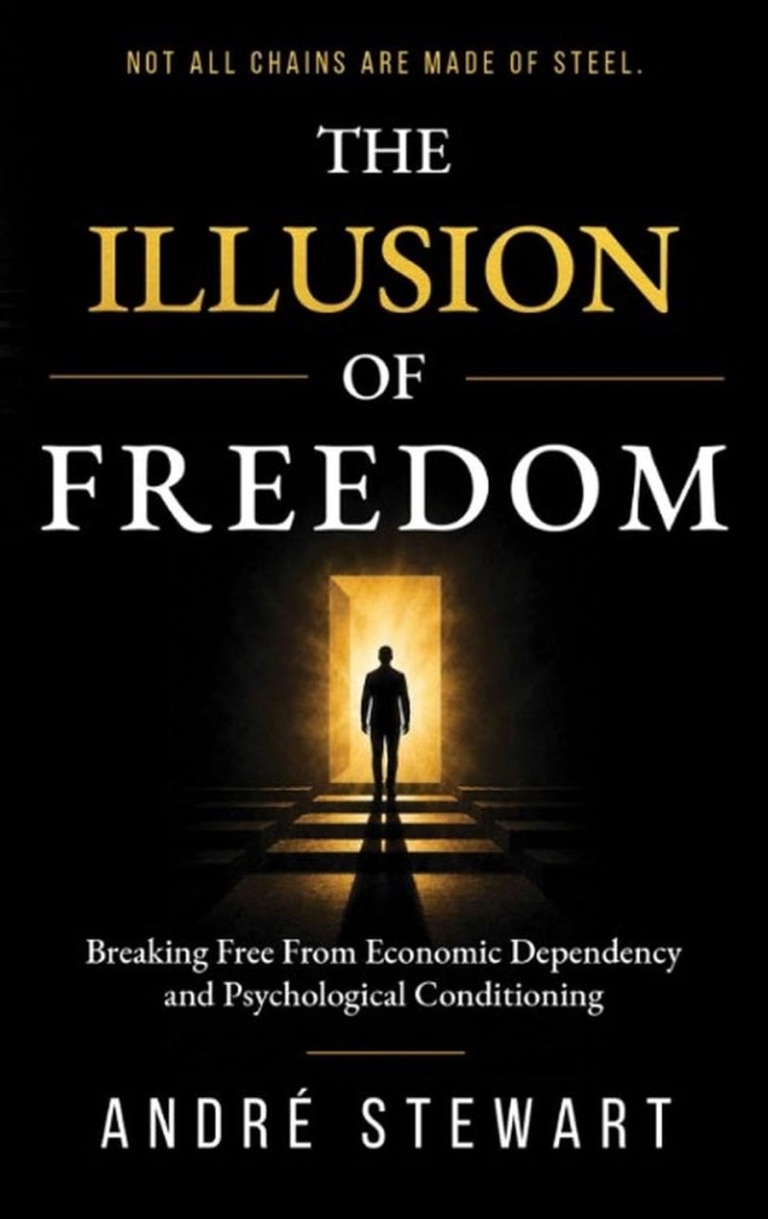
André Stewart explores that question in The Illusion of Freedom: Breaking Free From Economic Dependency and Psychological Conditioning, a book that invites readers to examine the systems, habits, and assumptions influencing their economic lives.
When Financial Security Still Feels Restrictive
Modern ideas about success often follow a familiar path. Build a career, increase income, establish credit, purchase possessions, and work toward greater security. André asks readers to look beneath those milestones and consider whether they are actually producing independence.
Released on October 14, 2026, The Illusion of Freedom approaches money through a combination of banking, behavioral economics, history, entrepreneurship, real estate, and personal observation. It is available in Kindle, hardcover, and paperback editions.
One of its central ideas concerns the relationship between income and control. Earning more money can certainly create opportunities, though income by itself reveals little about ownership, financial obligations, or control over time.
That distinction becomes especially important when debt enters the picture.
The book examines how financial obligations can gradually shape major life decisions. Monthly payments may influence where someone works, how long they remain in a particular career, whether they can pursue a business opportunity, and how comfortably they can respond to unexpected changes.
André encourages readers to understand those relationships before deciding what financial freedom means for them personally.
The Beliefs Behind Everyday Money Decisions
Some of the book’s most interesting questions reach beyond spreadsheets and bank accounts.
People develop beliefs about money throughout their lives. Ideas surrounding employment, credit, consumption, investing, and security can emerge from family environments, education, workplaces, advertising, and wider social expectations. Over time, those ideas may become so familiar that they receive little examination.
Awareness, in André’s view, creates an opportunity to reassess them.
His interest in these subjects grew partly from his own experiences. He grew up in poverty and later faced periods involving homelessness, unemployment, government assistance, depression, and financial instability. Close family ties to individuals directly connected to the legacy of slavery also contributed to his curiosity about history and the evolution of social and economic systems.
As his career developed, that curiosity gained a professional dimension.
Banking became his professional home for more than a decade, with roles at Silicon Valley Bank, Wells Fargo, Wachovia, and OneWest Bank. Through that work, he gained exposure to entrepreneurs, technology companies, corporations, venture-backed businesses, and high-net-worth individuals.
Seeing financial systems from inside the banking industry helped shape questions that eventually became central to The Illusion of Freedom.
The book places particular emphasis on the difference between earning money, owning assets, and controlling capital.
These concepts may sound closely connected, yet each can produce a different level of financial flexibility. A person may earn an impressive salary while carrying significant obligations. Another may own assets that generate income or provide additional choices. Understanding where someone sits within that spectrum can change the way they evaluate progress.
The book also looks at entrepreneurship and investing as possible ways to expand opportunity. André draws from his experience building businesses across real estate, lending, technology, and media to discuss the responsibilities accompanying those paths.
The larger message centers on creating options.
For readers, this might mean understanding debt more clearly, reconsidering spending patterns, developing assets, pursuing entrepreneurship, learning how capital works, or simply questioning assumptions that have influenced years of financial decisions.
About the Author
André Stewart is an entrepreneur, investor, and author whose career began in banking and who went on to found InvestFar and InvestFar Capital. He is also the host of the Investing Uncensored Podcast.

His background combines extensive banking experience with entrepreneurship in real estate, lending, technology, and media. His journey from economic hardship into banking, investing, and business ownership has shaped his perspective on financial dependency and independence.
André previously wrote the bestselling books The Real Estate Investing Diet and Epitome of the Mind. His work focuses on encouraging people to develop greater awareness of ownership, capital, financial decision-making, and personal control.
A Different Measure of Financial Progress
The Illusion of Freedom gives readers another way to evaluate financial success. Salary and possessions tell part of the story, while choices, ownership, and control can reveal much more about someone’s economic position.
André’s book ultimately encourages thoughtful examination rather than prescribing a single path. For anyone wondering whether years of hard work are creating genuine flexibility, its central question is especially relevant: are today’s financial decisions creating more options for tomorrow?
We had the privilege of interviewing the author. Here are excerpts from the interview:
Thank you so much for joining us today! Please introduce yourself and tell us what you do.
My name is André Stewart. I’m an entrepreneur, AI expert, capital strategist, investor, author, and integrative psychology practitioner. My career started in banking, where I spent more than a decade working with institutions including Silicon Valley Bank, Wells Fargo, Wachovia, and OneWest Bank. I had the opportunity to work with entrepreneurs, technology companies, business owners, investors, and high-net-worth individuals, which gave me an inside view of how capital, business, risk, and wealth creation actually work. Today, I build and operate companies across artificial intelligence, financial technology, real estate, private lending, decision intelligence, and media. Through InvestFar, I helped pioneer the idea of investing in real estate remotely, giving people the ability to evaluate, purchase, renovate, rent, sell, and manage investment property without needing to live in the market where they were investing. I’m also the founder of InvestFar Capital, creator of technology and AI-driven platforms, host of the Investing Uncensored Podcast, an author, and a market contributor to USA Today. A major part of my work now is focused on using AI to build companies, improve decision-making, analyze risk, automate operations, and help people and businesses make better strategic decisions. At the same time, my background in integrative psychology has made me equally interested in the human side of success: identity, beliefs, conditioning, decision-making, emotional triggers, and the unconscious patterns that often determine what people do with the opportunities in front of them. Outside of business, I’m a father and a huge sports fan. Sports were actually a major part of how I viewed success growing up, because for a long time I believed athletics or entertainment were some of the only realistic ways people from backgrounds like mine could truly make it. My work today is largely about expanding that picture.
Please tell us about your journey.
I grew up around poverty, and there were periods of my life that included homelessness, unemployment, government assistance, depression, and tremendous financial uncertainty. When you grow up in certain environments, your understanding of what is possible can become very narrow. For me, sports played a huge role in that.
Thank you so much, André, for giving us your precious time! We wish you all the best for your journey ahead!
Knowledge grows when shared. Please Pass it on!

Discover more from Paxjones
Subscribe to get the latest posts sent to your email.