

A private journal can preserve the details that public proceedings leave behind. In Diary of A Well-Disciplined Lawyer, Julian Drake gives that familiar object dangerous significance through the story of attorney Mina Salib. His secret account becomes a record whose discovery could unravel his cases and endanger his life.
The Evidence Between the Pages
The diary offers an intriguing starting point for this legal thriller. Written day by day during an escalating struggle, it holds information that powerful interests have reason to fear. Mina’s decision to keep it creates another responsibility alongside the cases already demanding his attention.
There’s an immediate sense of vulnerability in that premise. A document can survive its writer, travel beyond its intended audience, or fall into hands that understand its value. For Mina, the consequences of discovery are severe. His legal work could collapse, and the information he has preserved could place him in mortal danger.
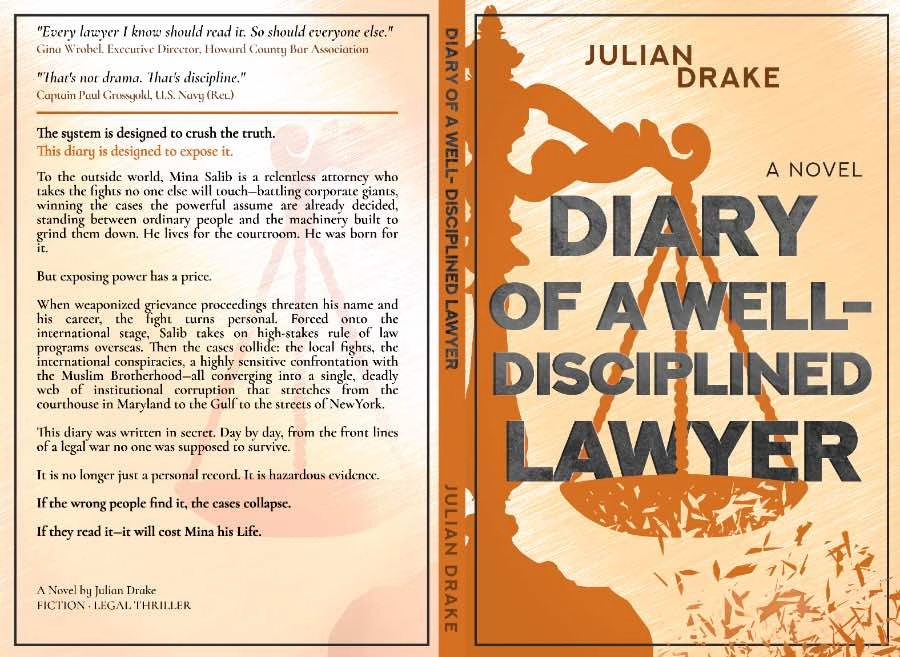
Readers are invited to consider the significance of keeping a record when every detail may carry consequences. The diary connects memory with evidence, giving the story a central object around which its threats gather.
It also lends meaning to the word “disciplined” in the title. Recording events consistently requires care. So does continuing legal work while facing opposition from people and institutions with considerable influence. Mina’s circumstances bring those demands together, placing persistence at the heart of the novel’s suspense.
Julian’s premise builds anticipation around what the diary contains, who might seek it, and how its existence affects the man who writes it.
Following the Pressure Beyond the Courtroom
Mina’s professional identity rests on his willingness to take difficult cases. He confronts corporate giants and represents ordinary people facing systems that can overwhelm their resources. The courtroom is the setting where his determination becomes action.
His opponents have power. He has the resolve to challenge them.
That commitment becomes costly when grievance proceedings threaten his name and career. Professional retaliation draws the conflict closer, forcing Mina to contend with attacks on the standing he needs to continue practicing. The threat reaches into his livelihood and his ability to serve the people depending on him.
The story then expands through his involvement in high-stakes rule of law programs overseas. Work across borders introduces further complications as local cases begin colliding with international conspiracies. Institutional corruption links settings that include Maryland, the Gulf, and New York.
A sensitive confrontation involving the Muslim Brotherhood adds to this fictional network of danger. As the strands converge, Mina’s responsibilities become harder to contain within the boundaries of any individual case.
This broader scope gives readers several reasons to engage with the story. Legal disputes carry professional consequences, international work introduces uncertainty, and the secret diary holds the possibility of exposure. Each element contributes to a premise centered on the effort required to pursue accountability under pressure.
The supplied advance praise reflects that emphasis. Captain Paul Grossgold, U.S. Navy (Ret.), draws attention to the discipline involved in justice-building work in volatile regions. Gina Wrobel, Executive Director of the Howard County Bar Association, recognizes the resolve associated with difficult ethical choices.
Author Dodzi Amemado, whose book is Surfing the Unknown, highlights the experience of confronting systems that exhaust those who challenge them. Their responses give prospective readers a sense of the human concerns surrounding the thriller’s legal conflicts.
About the Author
Julian writes under a pen name and identifies himself as a lawyer with thirty-five years of experience practicing law in America. In his note to readers, he explains that the novel draws partly on events he witnessed, cases he fought, and people he encountered.
He describes a narrator whose profession and life between two countries echo aspects of his own experience. The storytelling also includes material that has been invented, compressed, or reimagined.
His clarification matters: the book is fiction, and its characters are composites, inventions, or possibilities. Any resemblance to actual individuals, companies, organizations, or legal proceedings is stated to be coincidental and unintended.
Writing from Laurel, Maryland, Julian emphasizes freedom, enforceable agreements, and the rule of law. These principles provide a foundation for the convictions that animate Mina’s struggle.
What Remains on the Record
Diary of A Well-Disciplined Lawyer brings the pressures of legal advocacy into a story shaped by secrecy, persistence, and personal risk. Mina’s hidden account offers a compelling reason to follow his fight as its consequences widen. The novel is available in Kindle and paperback editions on Amazon.
Knowledge grows when shared. Please Pass it on!

Discover more from Paxjones
Subscribe to get the latest posts sent to your email.