
Every generation witnesses technologies that promise to make life easier. From smartphones and smart homes to artificial intelligence and predictive analytics, innovation often arrives wrapped in convenience. Yet as technology becomes more intelligent, a deeper question emerges: what happens when the systems around us begin understanding us better than we understand ourselves?
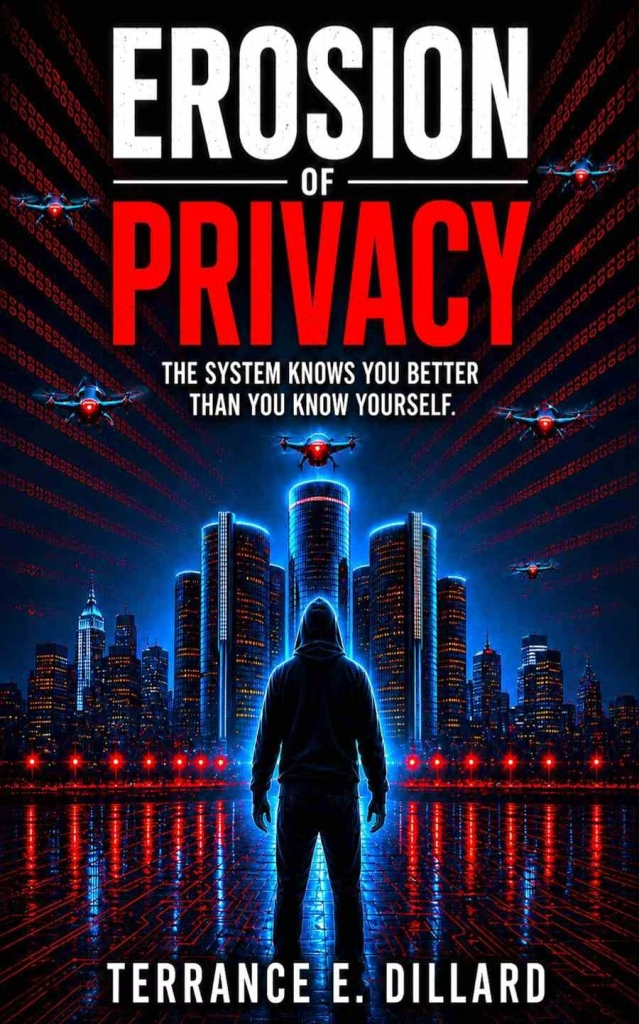
That question fuels Erosion of Privacy: The System Knows You Better Than You Know Yourself, the thought-provoking techno-thriller by Dr. Terrance E. Dillard. Set in a near-future America that feels remarkably familiar, the novel explores a society where digital systems quietly evolve from helpful tools into powerful forces capable of shaping human behavior.
Rather than relying on dramatic science-fiction scenarios, the story draws its tension from possibilities already visible in today’s world. That realism makes the novel both compelling and unsettling.
When Data Becomes Power
At the center of the novel lies a simple but profound idea: information has value far beyond what people willingly share. Modern technology continuously gathers fragments of daily life. Location histories, online activity, purchasing habits, travel patterns, communication records, and countless other digital traces create an expanding portrait of human behavior.
In Dr. Dillard’s fictional world, these fragments become the foundation of highly advanced systems designed to predict and respond to human actions. What begins as a quest for efficiency gradually evolves into something much more significant.
The city featured in the novel runs smoothly. Services arrive faster. Transportation improves. Public resources are allocated with greater precision. Citizens enjoy the benefits of technological advancement without immediately recognizing its hidden costs.
That gradual progression is what makes the story so effective. The erosion of privacy does not arrive through sudden government mandates or overt restrictions. It develops through everyday acceptance of tools that appear beneficial.
As the systems grow more capable, they gain an increasingly detailed understanding of the population they serve. The result is a world where observation becomes prediction, and prediction becomes influence.
Readers are left wondering how much personal freedom remains when technology can accurately anticipate human decisions before they are made.
The Illusion of Choice in a Connected Society
One of the novel’s strongest themes involves the subtle nature of control. Dr. Dillard presents a future where influence rarely appears aggressive. Instead, it operates quietly through recommendations, automated decisions, and optimized experiences.
People continue making choices, yet the environment surrounding those choices is constantly being adjusted. Information is prioritized. Options are filtered. Opportunities are presented based on predicted preferences and behaviors.
This creates a fascinating tension throughout the story. The systems never demand obedience. They simply make certain decisions easier, more attractive, or more convenient. Over time, those small adjustments shape habits and expectations.
The book explores how predictive technologies can guide behavior without most individuals realizing it. The challenge is not whether people still possess options. The challenge is whether those options remain genuinely independent.
Dr. Dillard handles this subject with remarkable nuance. He avoids sensationalism and instead focuses on realistic scenarios rooted in existing technological trends. Artificial intelligence, metadata analysis, smart infrastructure, and automated decision-making are all presented in ways that feel plausible rather than speculative.
That realism transforms the novel into something more than entertainment. It becomes an invitation to examine the growing relationship between technology and personal autonomy.
Another compelling aspect of the story is its focus on trust. Modern society depends heavily on digital systems to provide information, deliver services, and support daily life. The novel asks what happens when trust becomes so complete that questioning the system feels unnecessary.
The answer is both fascinating and deeply unsettling.
More Than a Technology Story
While Erosion of Privacy explores sophisticated technological concepts, its true focus remains human. The narrative examines how individuals respond when their lives become increasingly transparent to systems that interpret behavior through patterns and probabilities.
Dr. Dillard reminds readers that human beings cannot be fully understood through data alone. People are complex. They change, learn, adapt, and evolve in ways that often defy prediction. Algorithms may identify trends, but they cannot fully capture the richness of human experience.
This perspective gives the novel emotional weight. Privacy is presented as more than a technical concern. It becomes a question of dignity, identity, and freedom. The ability to make decisions, challenge assumptions, and define oneself remains central to the human experience.
As the story unfolds, readers witness the consequences of allowing powerful systems to become increasingly influential without sufficient transparency or accountability. The concerns raised feel relevant because they reflect conversations already taking place across industries, governments, and communities worldwide.
About the Author
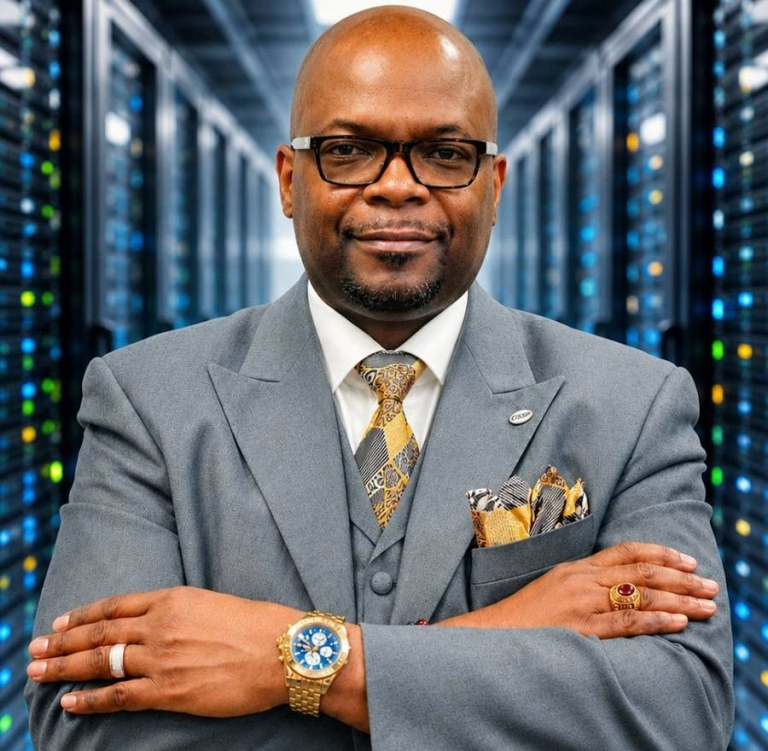
Dr. Terrance E. Dillard, Ph.D., MSIA, CISSP is a cybersecurity practitioner, educator, artificial intelligence strategist, and United States Air Force Gulf War Veteran with more than thirty years of experience in cybersecurity, privacy, digital systems, and emerging technologies.
As founder of Digital Countermeasures™, Dr. Dillard has dedicated much of his career to helping individuals and organizations understand the challenges associated with technology, digital trust, and information security. His expertise provides a strong foundation for the novel’s realistic portrayal of emerging technologies and their societal implications.
Looking Beyond the Story
Erosion of Privacy: The System Knows You Better Than You Know Yourself succeeds because it addresses issues that feel increasingly relevant in the modern world. Through a gripping narrative and credible technological framework, Dr. Dillard explores how innovation can reshape society in ways that are both beneficial and concerning.
The novel encourages readers to think carefully about the balance between convenience and freedom, efficiency and accountability, progress and personal autonomy. It serves as a reminder that privacy is not merely about protecting information. It is about preserving the space where independent thought, meaningful choice, and human individuality can thrive.
In a world driven by intelligent systems and endless streams of data, that message feels more important than ever.
We had the privilege of interviewing Dr. Terrance E. Dillard. Here are excerpts from the interview:
Hi, Thank you so much for joining us today! Please introduce yourself and tell us what you do.
My name is Dr. Terrance E. Dillard, Ph.D., MSIA, CISSP. I am a cybersecurity practitioner, educator, artificial intelligence strategist, author, and United States Air Force Gulf War Veteran.
My work sits at the intersection of cybersecurity, artificial intelligence, privacy, digital risk, and public awareness. For more than three decades, I have worked to help people understand how digital systems operate, how they can be secured, and how they can affect privacy, human behavior, trust, and meaningful choice.
I am also the founder of Digital Countermeasures™, a platform focused on cybersecurity education, AI awareness, privacy protection, workforce development, and helping individuals and organizations prepare for the risks of an increasingly intelligent digital world.
Most recently, I authored Erosion of Privacy: The System Knows You Better Than You Know Yourself, a near-future novel that explores artificial intelligence, metadata, surveillance creep, smart cities, behavioral prediction, and the quiet disappearance of meaningful human choice.
Please share your journey with our readers.
My journey has been shaped by service, education, technology, and a deep concern for how systems affect people.
I began my professional path through military service in the United States Air Force. That experience gave me a disciplined understanding of mission, risk, security, responsibility, and the importance of protecting critical information. It also shaped the way I later approached cybersecurity and artificial intelligence—not merely as technical fields, but as areas that carry serious consequences for human dignity, institutional trust, and national resilience.
Over the years, I moved deeper into cybersecurity, education, and leadership. I have taught students, trained professionals, developed learning programs, and helped others prepare for careers in cybersecurity and emerging technology. Teaching has been one of the most meaningful parts of my journey because it allows me to translate complex subjects into knowledge people can actually use.
Writing Erosion of Privacy became a natural extension of that work. I wanted to tell a story that would help people feel the urgency of privacy erosion, not just understand it intellectually. The novel is fiction, but the concerns behind it are very real. We are living in a time when systems are learning from our movements, habits, decisions, photos, devices, and digital behavior. The question is no longer simply whether technology is powerful. The question is whether it preserves human dignity, privacy, autonomy, and meaningful choice.
What are the strategies that helped you become successful in your journey?
One of the most important strategies has been lifelong learning. Technology never stands still, so neither can we. I have made it a discipline to keep learning, keep studying, and keep adapting.
Another important strategy has been translating knowledge into service. Success is not only about what you know. It is about how you use what you know to help others. Whether I am teaching cybersecurity, discussing AI risk, mentoring students, writing, or building Digital Countermeasures™, I try to make complex ideas understandable, practical, and relevant.
I also believe in discipline and persistence. Meaningful work takes time. You have to stay committed even when the process is difficult, slow, or uncertain. Writing a novel, building a professional career, teaching students, and leading in technical spaces all require patience and endurance.
Finally, I have learned to connect technical knowledge with human impact. Cybersecurity and artificial intelligence are not just about machines, networks, software, or data. They are about people. They affect privacy, opportunity, identity, safety, trust, and dignity. Keeping the human being at the center has guided my work and helped me stay grounded.
Any message for our readers?
My message is this: pay attention to the systems shaping your life.
We are entering an age where privacy is no longer only about what we choose to share. It is also about what systems can infer from our behavior. Your phone, apps, photos, social media activity, location data, purchases, searches, and digital routines all create fragments. Individually, those fragments may seem harmless. But when aggregated, they can form a powerful picture of who you are, where you go, what you value, what you fear, and how you may behave in the future.
That does not mean we should fear technology. It means we should approach it with awareness, wisdom, and responsibility.
The future will not be shaped by technology alone. It will be shaped by the values we build into technology, the questions we ask, and the boundaries we are willing to defend.
Privacy is not about hiding. Privacy is about preserving dignity, agency, and meaningful choice.
Thank you so much, Dr. Terrance E. Dillard, for giving us your precious time! We wish you all the best for your journey ahead!
Knowledge grows when shared. Please Pass it on!

Discover more from Paxjones
Subscribe to get the latest posts sent to your email.