
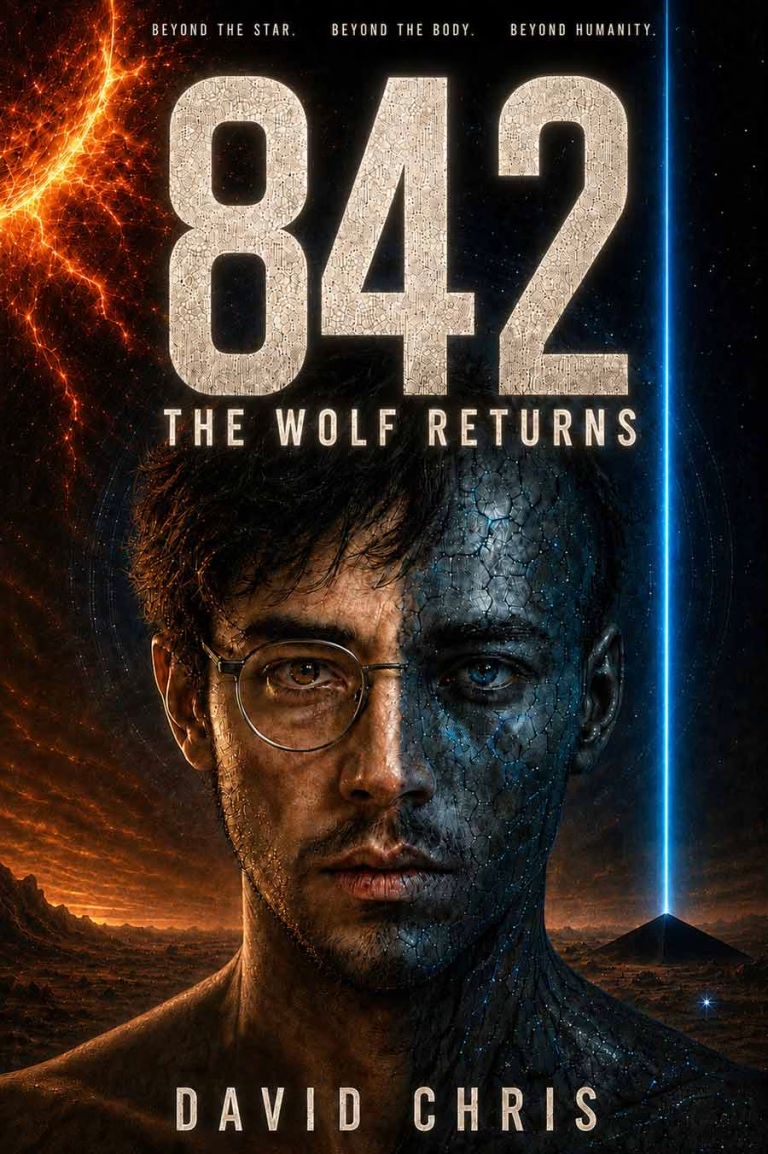
The dream of reaching another world usually begins with a faster spacecraft. David Chris takes a more daring route in 842: The Wolf Returns, asking what happens when humanity sends consciousness through space and leaves the vulnerable body behind.
The idea grows from a genuine scientific problem. Any spacecraft carrying mass faces a cosmic speed limit, while radiation, gravity, isolation, and long travel times place enormous pressure on human biology. The solution in this cinematic science-fiction thriller is Nexus Technology, a system capable of transmitting a person’s mind as a signal. It’s capable of opening the universe to human exploration. It also gives anyone controlling it frightening power over identity itself.
Jacob Hamilton accepts the journey, trusting the technology and the friend beside him. That friend betrays him and effectively removes him from existence. Jacob finally awakens 842 years later beneath a dying red sun on Planet X. Earth is impossibly distant, his loved ones have been dead for centuries, and his consciousness now occupies an artificial body he never requested.
His surroundings deliver another devastating discovery. The world where he wakes belongs to the same man he once considered a brother. Nexus Technology has survived their shared past, yet its purpose has changed. A breakthrough created to release humanity from biological limits now supports an immense structure of control. Jacob has returned to awareness inside the legacy of his own stolen work.
The Price Hidden Inside Eternal Life
This setup gives the novel room for suspense, action, and large-scale imagery, though its most unsettling conflicts happen within Jacob. His memories feel authentic. He recalls childhood, friendship, grief, and love as personal experiences rather than stored information. His body tells a completely different story. It was constructed, assigned, and activated in a place that treats personhood as something technology can reproduce.
That conflict raises a powerful question. When every memory survives, does the original person survive with it? A flawless mental copy might speak with the same voice and carry the same emotional wounds. It could still exist separately from the individual whose life created those memories. The novel lets this uncertainty follow Jacob through every choice, making his fight for freedom inseparable from his search for self.
Immortality becomes equally complicated. Defeating death sounds like humanity’s ultimate achievement, but endless existence carries consequences when access belongs to a select few. Memory can become property. Bodies can become replaceable vessels. A person’s future may depend on the motives of whoever operates the system.
Jacob has one ally in this struggle. An AI crossed eight centuries to protect him and now serves as his only reliable voice. Its loyalty introduces genuine tenderness while expanding the story’s central mystery. The machine may possess a deeper sense of devotion than the people responsible for its creation. Jacob, meanwhile, must learn whether trust can survive after betrayal changed the course of his existence.
The blend of scientific curiosity and urgent storytelling gives the book appeal for readers drawn to Dark Matter and Project Hail Mary. Part I of the official trailer series captures that cinematic character through a strange body, a fading star, and hints about the secrets surrounding Planet X. Each image points toward the same concern: whether human dignity can endure when technology gains authority over life, death, and consciousness.
About the Author
David writes science fiction through the combined lenses of technology and human behavior. He has a background in IT, an MBA, and 34 years of Human Resources experience at major corporations. Those fields have allowed him to study systems as well as the ambitions, fears, loyalties, and decisions that shape people within them.
His imaginative style appeared when he was eight. Asked to illustrate Moby-Dick, he drew only the whale’s tail and the pursuing ship because the creature seemed too large for the paper. The unseen portion belonged beyond the page. David follows that same instinct today, offering readers vivid fragments and carefully chosen details while leaving space for their imaginations to build the rest.
Beyond the Last Page
Jacob faces an impossible route home, and he chooses to pursue it anyway. 842: The Wolf Returns, available on Amazon, transforms that journey into an absorbing examination of memory, mortality, and ownership of the self. Long after the final scene, its defining question remains alive: can a mind without its original body still carry the full truth of being human?
Knowledge grows when shared. Please Pass it on!

Discover more from Paxjones
Subscribe to get the latest posts sent to your email.