

Stepping Into a Story of Faith, Fire, and Fragile Morality
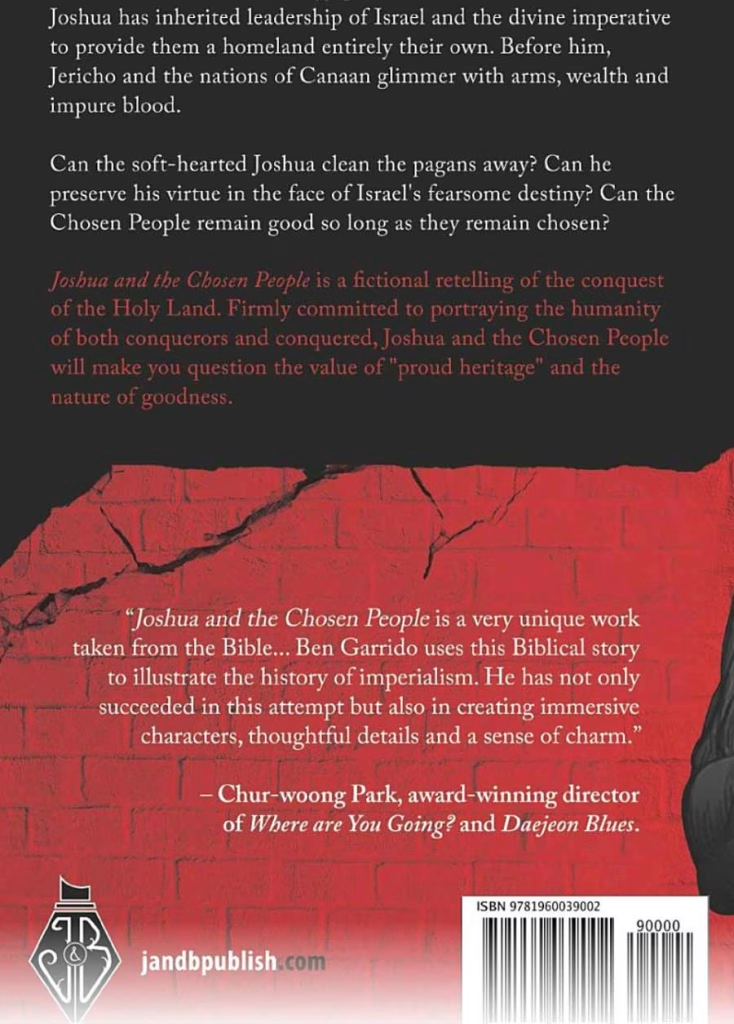
In Joshua and the Chosen People, author Ben Garrido revisits one of history’s most intense and debated moments and reshapes it into a deeply human work of historical fiction. The novel follows Joshua as he assumes leadership of the Israelites after Moses, carrying both the weight of command and a divine mission that leaves little room for hesitation. The goal is clear: secure a homeland for the Chosen People. The path there is anything but simple.
This is not a story that treats conquest like a victory parade. Garrido frames it as a moral storm. Jericho stands ahead like a symbol of power and resistance, surrounded by the nations of Canaan, rich in resources, armed to defend themselves, and described through the eyes of the Israelites as spiritually impure. Yet the book immediately raises a troubling question: if the Israelites are meant to represent holiness, what happens when holiness must arrive through violence?
Joshua, at the center of it all, is portrayed as a leader who feels deeply, perhaps too deeply for the brutal role destiny has assigned him. That softness becomes the book’s emotional engine, making every step toward battle feel heavy with consequence.
Joshua as a Leader Who Carries More Than a Sword
Many historical novels rely on a fearless hero who charges forward with certainty. Garrido takes a different approach. Joshua is brave, yet he is also reflective. He has inherited a mission that demands strength, but his conscience refuses to stay quiet. He is not simply fighting enemies. He is fighting the possibility that he may lose himself in the process.
The Israelites are not portrayed as flawless followers either. They are a people shaped by wandering, fear, and dependence on divine guidance. Now they are asked to become conquerors. That shift creates tension in the camp, and Joshua must hold them together while also holding himself steady. He must inspire faith while managing doubt. He must offer confidence while quietly questioning whether he is the right man for such a task.
This inner conflict is what gives Joshua and the Chosen People its pulse. The story becomes less about military triumph and more about psychological survival. The battles matter, but the greater struggle takes place within the minds of those who believe they are chosen for something sacred.
Joshua’s virtue is tested repeatedly. The book asks whether goodness can survive when it is paired with entitlement. Can a people remain righteous while believing they have divine permission to take what others call home? These are uncomfortable ideas, and Garrido does not soften them.
The Conquered Are Not Shadows in the Background
One of the strongest qualities of the novel is the way Ben portrays both sides of the conflict with dignity. The Canaanites are not treated as faceless obstacles. They are given humanity, emotions, and motivations. Their world is not presented as meaningless simply because Joshua’s people see it as pagan.
That choice gives the story depth. Jericho becomes more than a target. It becomes a living place, filled with individuals who love their families, fear invasion, and cling to their traditions. Readers are encouraged to see the conquest as a collision of human lives rather than a clean moral equation.
This balanced portrayal pushes the novel into a rare space. It becomes a story where readers may sympathize with opposing sides at the same time. That emotional complexity is exactly what makes the book linger in the mind.
The title itself hints at the larger theme. Being chosen sounds like an honor, yet it also becomes a burden. The Israelites carry pride, but they also carry responsibility. The novel repeatedly challenges the assumption that heritage automatically equals righteousness. Instead, it suggests that moral goodness is fragile, especially when power enters the picture.
Rather than offering a neat resolution, Ben invites readers to wrestle with the same questions Joshua faces. What is justice when everyone believes they are right? What is faith when it requires destruction? What is purity when blood must be spilled to achieve it?
A Historical Fiction Novel With a Philosopher’s Depth
Ben Garrido is no stranger to ambitious storytelling. He is the lead author of the Enclave Series, known for high-energy adventures set in an intense small-town world, and the Old Heroes Series, which reimagines famous myths and legends from Greece, the Bible, Babylon, and Egypt. That background explains his ability to work with legendary material while still making it feel fresh and personal.
His academic life also adds a unique layer. Ben is a professor of educational philosophy at Shimonoseki City University in Southern Japan, and he has written textbooks, essays, and academic papers exploring philosophy and education. That intellectual foundation shows up in the moral structure of Joshua and the Chosen People. The book reads like a story, yet it carries the weight of ethical inquiry beneath every chapter.
Even so, the writing remains accessible. The narrative flows with energy, blending action with introspection. The violence of conquest is present, but it is never glorified. Instead, it feels tragic, inevitable, and psychologically costly. The tone stays grounded, making the ancient world feel surprisingly close.
Readers who pick up this book expecting a simple biblical retelling may be surprised. It is far more reflective than expected. It challenges the idea of heroic conquest and instead focuses on the emotional consequences of believing one has been selected by God.
Ultimately, Joshua and the Chosen People is a historical fiction novel that does something rare. It respects the epic scale of its source while refusing to ignore the human pain inside it. Joshua is not presented as a perfect leader. He is presented as a man standing between faith and fear, destiny and doubt.
For anyone drawn to historical fiction that explores morality rather than just battles, Ben’s novel offers a gripping and thought-provoking journey. It is a story of courage, uncertainty, and the unsettling cost of carrying a sacred mission into a violent world.
We had the privilege of interviewing the author. Here are excerpts from the interview:
Hi, thank you so much for joining us today! Please share about yourself with our readers.
My name is Ben Garrido, and I’m a professor of educational philosophy at Shimonoseki City University in Southern Japan. I’m also the author of several novels, two textbooks, and a couple more book projects coming out soon.
I read and enjoy a very wide variety of literature, particularly the classics. Cervantes made me laugh until it hurt, the poetry of Hafiz is the perfect way to enjoy a quiet afternoon, Homer hit me hard enough that I’m still mad at Paris and Helen, etc. Among more modern writers, I tend to enjoy writers who address complex and contentious topics without judgment or editorialization. Cormac McCarthy’s “The Road,” Thomas Savage’s “The Power of the Dog,” Mohsin Hamid’s “Reluctant Fundamentalist,” and Carlos Fuentes’ “Gringo Viejo” are some recent novels I’ve really enjoyed, while in the field of non-fiction, I absolutely adored Alice Dreger’s “Galileo’s Middle Finger,” Candace Millard’s “The River of Doubt,” and Lee McIntyre’s “Post-Truth.”
If I’m allowed to mention some Korean authors not currently translated into English, I would also like to recognize Kim Yong-kyu’s excellent “Era of Thought” (김용규, 생각의 시대), and Park Jae-hee’s wonderful “One Lesson Per Day Guide to Lao Tzu’s Book of Morality” (박재희, 1일 1강 도덕경 강독) as works I’ve learn much from, and authors I admire.
Please tell us about your journey.
I’m originally from Reno, Nevada. I’d planned to finish my degree at UNR, get a job in journalism, and work as a reporter. Unfortunately, things timed out just perfectly that I graduated into the deepest part of the Great Recession. The entry-level reporter jobs I found paid around 1300 dollars a month and required me to move to very expensive cities.
Instead, I found a job in South Korea paying about double that, with a much lower cost of living. I soon discovered that South Korean grad schools are also about 10% as expensive as US grad schools, and that the education was both high quality and impressive on the resume. It also gave me the opportunity to learn the Korean language, to get involved with big academic publishers, and to learn the incredibly rich tradition of Confucian, Taoist, and Legalist philosophy.
There is absolutely no way in hell I’d have been able to afford an MA or PhD in the US, so my academic career really does exist thanks to the excellent South Korean system.
I was offered a tenure-track professorship in 2024 in Southern Japan. I accepted this offer, and now live in Yamaguchi Prefecture. The move was quite sudden, and I didn’t have any opportunity to learn Japanese before I arrived, so, to my great shame, I’m not able to recommend any untranslated Japanese writers at this time.
What are the strategies that helped you become successful in your journey?
I worked hard to identify the things my peers were bad at, or afraid to do. When I was still living in the US, the greatest weakness I noticed in my peers was a tendency to be overly opinionated and inflexible. I responded to this by learning to hide my opinions and adapt to the beliefs and customs of the people around me.
When I moved to Korea, the biggest weakness I noticed in my peers was an unwillingness to learn the language, and a tendency to frame East Asian problems in the terms of Western morality. I adapted to these weaknesses by studying Korean and learning to judge problems from a Korean moral perspective.
When I began to work in academia, the biggest weakness I found was risk-aversion. Many of my peers were afraid to stray too far from the dominant schools of thought, too far from the methods prescribed in the biggest textbooks, too afraid to take research in new directions. I adapted to these weaknesses by both taking risks and learning how to encourage others to perceive those risks as not-so-scary. To put this more succinctly, this was the time in my life when I started seriously learning how to engineer my social environment.
Any message for our readers?
There’s no greater sign of intellectual and artistic integrity than to deeply understand the feelings, thoughts, and passions of your enemies. This does not make you soft, it does not make you a wimp, it does not make you a traitor to your own causes. On the contrary, it makes you the most powerful and useful version of yourself.
Thank you so much, Ben, for giving us your precious time! We wish you all the best for your journey ahead!
Knowledge grows when shared. Please Pass it on!

Discover more from Paxjones
Subscribe to get the latest posts sent to your email.