
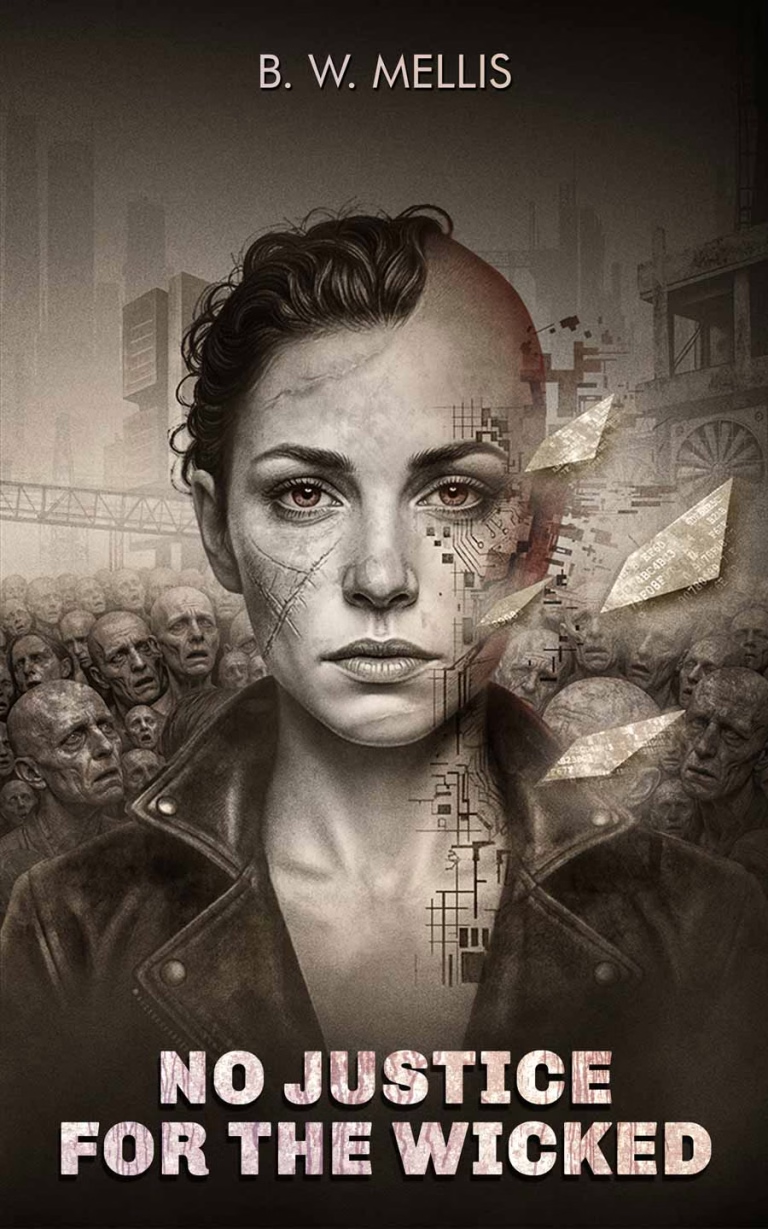
How much can be taken from a human being before the person underneath begins to disappear? B.W. Mellis places that unsettling question at the heart of No Justice for the Wicked, a debut novel built around oppression, psychological destruction, and the relentless machinery of authoritarian power.
Spanning 87,000 words, the novel moves through extreme speculative horror, dark dystopian fiction, and political horror. Its graphic intensity comes with extensive content warnings, preparing readers for a story that deliberately ventures into deeply disturbing territory.
A Future Europe Ruled Through Suffering
The world of No Justice for the Wicked has already experienced devastating decline. Within the ruins of Europe, the Creynian Empire has established a social order dependent upon division, fear, and systematic cruelty.
At the bottom of this hierarchy are the Flawborn. Scarred and marginalized, they live without meaningful rights. Hunger, confinement, and segregation define their existence, while the empire treats their suffering as an ordinary component of its structure.
Kira Navarro once believed resistance could change that reality. Alongside her husband, Elian Morgan, she helped lead the final organized effort against the regime. Their rebellion ended in failure, and the consequences bring them into the hands of the immortal emperor Octavius Volkov.
Volkov has plans that extend far beyond punishment.
Kira and Elian become subjects in the development of a systematic brainwashing methodology. Physical pain forms only one component of the process. The experiments target everything capable of anchoring someone to a recognizable human identity. Family, affection, beauty, spirituality, grief, memory, and emotional connection are systematically attacked.
The terrifying scope of Volkov’s project eventually becomes clear. The methodology is intended for widespread use, transforming individual experimentation into an industrialized system of dehumanization.
When Horror Becomes Psychological
Mellis uses Kira’s experience to examine a frightening possibility: what happens when a regime understands that destroying identity can become another form of control?
That question gives the novel its psychological force.
Kira’s body can endure extraordinary damage, yet survival creates its own nightmare. An excerpt describing her bones regenerating turns physical agony into an almost cosmic meditation. Her suffering leads toward questions about existence itself, including whether pain is somehow embedded within creation and whether genuine peace can still exist.
These moments reveal the literary ambitions within the novel’s extreme-horror framework. The story explores ideology, faith, power, resistance, and the vulnerability of the human psyche while maintaining an exceptionally graphic approach to its fictional world.
Historical influences deepen those themes. Mellis drew inspiration from twentieth-century Romanian history, including the Pitești Experiment and the Ceaușescu regime. Within her speculative setting, these influences contribute to an examination of what can happen when institutions attempt to reshape people through coercion and psychological destruction.
Early readers have drawn comparisons with Cormac McCarthy, George Orwell, and Margaret Atwood. The novel also occupies territory familiar to extreme-horror audiences who read writers such as Aaron Beauregard, John Athan, Kristopher Triana, and Wrath James White.
A Novel Designed for Experienced Horror Readers
No Justice for the Wicked makes its content level clear. The novel contains graphic torture, extreme violence, starvation, forced cannibalism, bodily mutilation, psychological manipulation, child death, self-harm, suicide, religious coercion, and systematic attacks on identity.
There is also a brief, non-explicit scene involving sexual violence in the context of religious desecration. The material is presented with a clear warning, allowing readers to make an informed decision before entering Mellis’s fictional world.
Its audience will likely include readers of extreme horror and splatterpunk alongside those drawn to serious dystopian and political fiction. Fans of stories examining authoritarianism may find particular interest in the mechanisms through which the Creynian Empire maintains control.
At its core, Kira’s journey remains intensely personal. Her struggle asks whether humanity can survive after the things giving life meaning have been deliberately dismantled.
About Author B.W. Mellis
B.W. Mellis has spent five years developing her writing and has earned publication in several literary magazines. One of her short stories recently won an award for new writers, while her self-published catalogue has been under development for three years.
No Justice for the Wicked is her debut novel. Mellis’s work combines literary extreme horror with psychological, speculative, and dystopian fiction. Her stories frequently explore dehumanization, ideology, power, faith, existential uncertainty, and the fragile boundaries of the human psyche.
Into the Darkness
With No Justice for the Wicked, Mellis has created a grim fictional world where political oppression reaches directly into the mind, body, and emotional identity of its victims.
The result is a demanding debut intended for readers prepared for extreme material and difficult questions. Beneath its brutality lies a haunting inquiry that follows Kira throughout her ordeal: when everything meaningful has been taken away, what remains?
Knowledge grows when shared. Please Pass it on!

Discover more from Paxjones
Subscribe to get the latest posts sent to your email.