
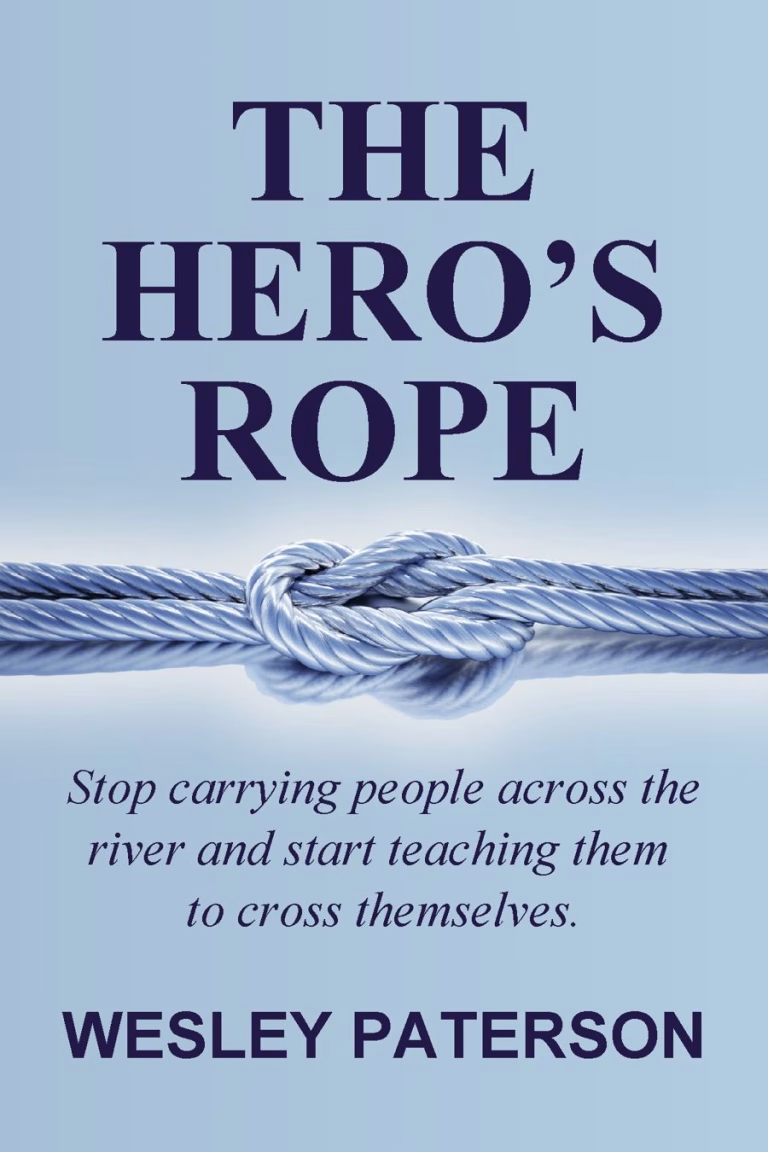
Leadership advice has long emphasized support, empathy, and accessibility. These qualities sound ideal, and in many ways, they are. However, Wesley Paterson presents a perspective that turns this familiar narrative on its head. His work suggests that what many leaders consider helpful may actually be holding their teams back.
First Impressions
Wesley Paterson, a Certified Management Consultant with decades of experience, introduces a concept that feels both surprising and necessary. In The Hero’s Rope, he challenges the idea that leaders should constantly step in to guide, fix, and protect.
At first glance, this approach may seem counterintuitive. Leaders are often praised for being available and involved. Yet Wesley argues that this constant involvement creates a hidden cost. When leaders solve every problem, they prevent others from developing the skills needed to solve those problems themselves.
This insight is grounded in years of observing organizational patterns. Across industries, Wesley noticed a recurring issue. Teams that received the most support were often the least capable of operating independently. The connection was the result of repeated intervention.
When Support Becomes a Limitation
Wesley explains that over-supportive leadership can unintentionally create what he calls a dependency loop. Employees begin to rely on leaders for direction, even in situations where they are fully capable of acting on their own.
This reliance grows stronger over time. Tasks that should require minimal guidance start to involve multiple check-ins. Decision-making slows down. Confidence begins to decline. Eventually, individuals stop taking initiative altogether.
There is also a subtle cultural shift that takes place. Teams start to equate leadership with problem-solving rather than development. The expectation becomes clear. When something goes wrong, someone else will step in.
Wesley points out that this dynamic can also distort recognition within an organization. Those who frequently seek help may receive more attention, while independent contributors remain in the background. This imbalance reinforces the behavior that leaders are trying to avoid.
For leaders, the impact is equally significant. Constant involvement creates pressure. It reduces the ability to focus on long-term goals and strategic thinking. Instead of guiding the organization forward, leaders become absorbed in managing day-to-day challenges.
The Philosophy Behind the Hero’s Rope
The core idea Wesley presents is simple yet transformative. Leadership should be about enabling growth. This is where the metaphor of the Hero’s Rope becomes meaningful.
Rather than carrying individuals across challenges, leaders provide a framework that allows them to navigate those challenges independently. The rope represents guidance and support without control.
Wesley’s background in martial arts plays an important role in shaping this philosophy. In that environment, progress comes through practice and persistence. Skills must be developed through experience.
Applying this principle to leadership means creating opportunities for growth, even when those opportunities involve discomfort. Leaders encourage exploration, allow mistakes, and support learning. The focus shifts from immediate results to long-term capability.
This approach requires a different kind of discipline. It involves resisting the urge to step in at the first sign of difficulty. It also requires confidence in the team’s ability to grow through experience.
Why This Shift Matters

Wesley’s insights highlight a broader issue within modern organizations. Many workplaces struggle with adaptability. They face challenges that require quick thinking and independent action, yet their teams are conditioned to wait for direction.
By shifting the focus toward capability, organizations can build stronger foundations. Teams become more resilient. They respond to challenges with creativity and confidence. This shift also creates a more balanced environment where responsibility is shared rather than concentrated.
Wesley emphasizes that discomfort is an essential part of this process. Growth develops through effort and persistence. Leaders who understand this are better equipped to create environments where progress feels meaningful.
Another key aspect of this shift is trust. Leaders must trust their teams to handle challenges. At the same time, teams must trust that they have the freedom to act. This mutual trust becomes the foundation for a more effective and sustainable culture.
About the Author
Wesley Paterson, CMC, is the founder of Paterson Consulting Inc. in Alberta, Canada. A Certified Management Consultant with more than 500 consulting projects behind him, he has worked across energy, manufacturing, healthcare, and government sectors, helping organizations improve performance, strengthen leadership, and build lasting operational excellence.
Wesley brings a distinctive perspective to leadership through both business and martial arts. He is a 4th-degree black belt in Budo Taijutsu, a 2024 International Constantinus Award Nominee and National Champion of Canada, a Queen Elizabeth II Platinum Jubilee Medal recipient, and was part of the firm recognized as Management Consultancy Firm of the Year 2025. Through The Hero’s Rope, Wesley challenges leaders to stop creating dependency and start building real capability.
Final Reflections
The Hero’s Rope offers a thoughtful and practical perspective on leadership. It challenges widely accepted ideas and encourages a more intentional approach.
Wesley presents a clear message. Leadership is about creating the conditions for others to succeed independently.
By stepping back at the right moments and focusing on development, leaders can build teams that are capable, confident, and prepared for the challenges ahead.
We had the privilege of interviewing the author. Here are excerpts from the interview:
Thank you so much for joining us today! Please introduce yourself and tell us what you do.
I’m Wesley Paterson, CMC, founder of Paterson Consulting Inc. in Alberta, Canada. I’m a Certified Management Consultant specializing in manufacturing optimization, organizational excellence, and leadership development. I’ve completed over 500 consulting projects across energy, manufacturing, healthcare, and government sectors.
Please tell us about your story/journey.
Over two decades of consulting, I kept seeing the same pattern: well-meaning leaders creating dependency by rescuing their teams instead of building capability. Combined with my martial arts training (4th-degree black belt in Budo Taijutsu), I developed a framework that distinguishes helping from rescuing. That became THE HERO’S ROPE.
What are the strategies that helped you become successful in your journey?
Relentless focus on results, not theory. Every framework in the book was tested across 500+ real consulting engagements. I also credit mentors like Dr. Gary Helgeson, and the discipline I gained through martial arts training.
Any message for our readers
Stop rescuing people from discomfort. Discomfort is the currency of growth. If you want to build capable, anti-fragile teams, you need the courage to let people struggle, learn, and climb their own rope.
Thank you so much, Wesley, for giving us your precious time! We wish you all the best for your journey ahead!
Knowledge grows when shared. Please Pass it on!

Discover more from Paxjones
Subscribe to get the latest posts sent to your email.