
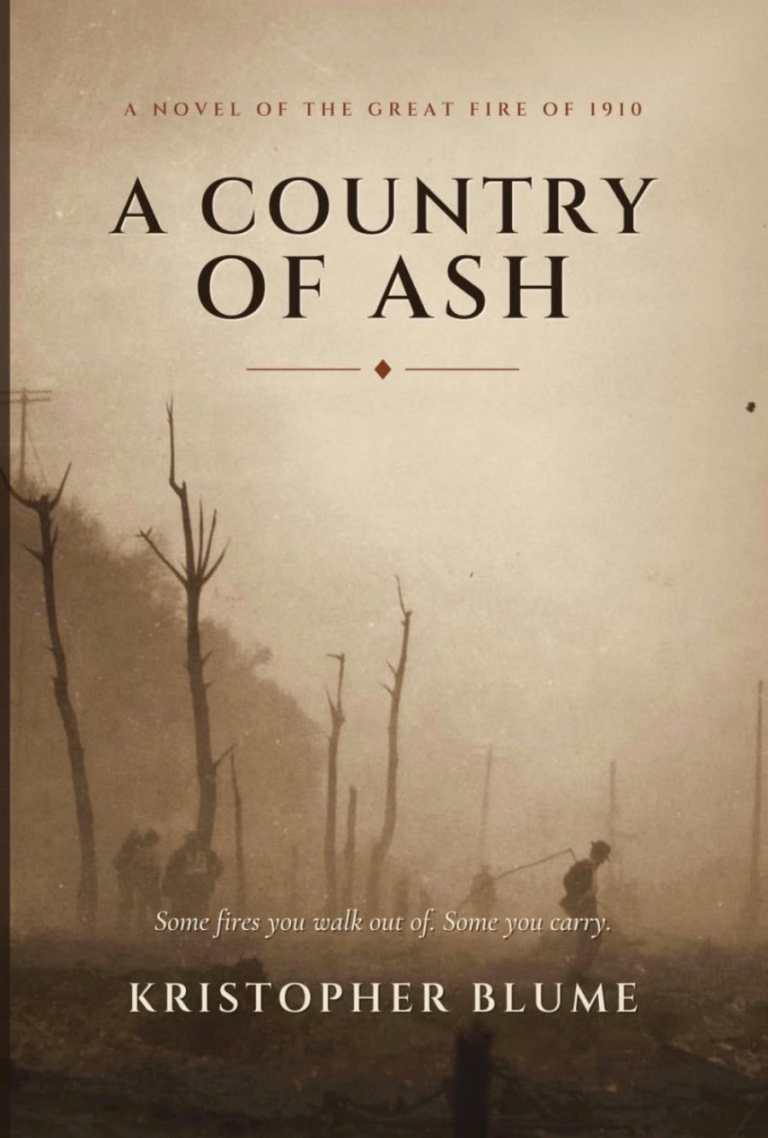
History often records a disaster through dates, acreage, and lives lost. A Country of Ash by Kristopher Blume looks deeper, placing one grieving man at the center of the 1910 Big Burn and exploring the emotional cost of survival.
Through Silas Dunne’s journey, the novel examines duty, guilt, prejudice, courage, and the fragile hope that can remain after everything familiar has burned away.
From a Chicago Tragedy to the Idaho Mountains
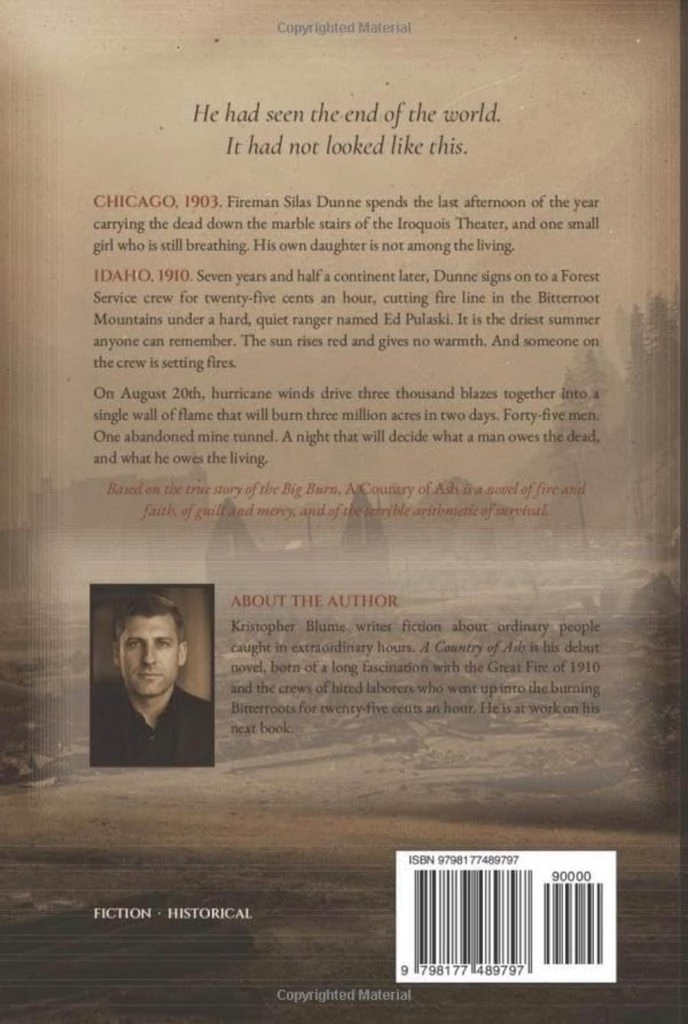
Before Silas reaches the forests of Idaho, fire has already taken the life he knew. In 1903, he enters Chicago’s Iroquois Theater during one of the deadliest building fires in American history. Inside, he finds a wall of bodies and manages to rescue a small girl who is still alive.
His own daughter is among those who perish.
The experience stays with him for the next seven years. By 1910, Silas has become a drifter carrying thirty-one cents and a brass fireman’s badge. The badge serves as one of his final connections to his former identity, though he can’t bring himself to throw it away.
His travels lead him to Wallace, Idaho, a mining town surrounded by the Bitterroot Mountains. There, he joins a Forest Service crew and begins cutting fire line for twenty-five cents an hour. The men work under ranger Ed Pulaski, whose quiet authority and practical discipline command attention.
The landscape already shows signs of approaching disaster. It’s the driest summer anyone can recall. The sun appears red in the sky, and ash settles over Wallace with the softness of winter snow. Kristopher uses these details to create a steady feeling of unease. The danger is visible, yet its true scale remains difficult to imagine.
Silas understands fire better than most. He also knows how quickly an ordinary day can become a permanent dividing line between the life someone had and the life that follows.
Loyalty, Suspicion, and a Gathering Threat
Life on the mountain gives Silas a new group of people to observe, protect, and eventually depend upon. Among them is a red-haired Irish boy from Butte. Silas takes the young worker under his wing, and their bond awakens a protective instinct that grief has never fully erased.
Tensions rise as fires continue appearing across the region. Exhaustion and fear leave the crew searching for someone to blame. Their anger falls upon an immigrant accused of starting the blazes, and the situation moves dangerously close to a lynching.
Silas steps between the man and the rope.
The moment reveals the moral foundation of his character. His bravery appears through a willingness to defend another person when the crowd has surrendered to suspicion. That choice also reinforces one of the novel’s central concerns: survival has meaning when people preserve their humanity under pressure.
Questions surrounding the fires continue to trouble him. Evidence suggests that someone may be setting them deliberately. Silas develops a suspicion about the culprit, and the possible answer fills him with dread.
Kristopher allows these human conflicts to unfold beneath the growing environmental threat. Readers see personal loyalties forming while mistrust spreads through the crew. Every unresolved tension becomes more urgent as the wind begins to change.
On August 20, hurricane-force winds combine three thousand separate fires into a massive wall of flame. The inferno races across the region, ultimately burning three million acres and destroying a third of Wallace. Escape routes disappear. Smoke fills the sky, and the mountains become a deadly maze.
Pulaski leads forty-five men into the abandoned Nicholson mine tunnel. They hang wet blankets across its entrance and wait together as the fire approaches.
This historical episode gives the novel its defining test. Inside the tunnel, rank and reputation matter less than endurance, trust, and the choices made during desperate minutes.
About the Author
Kristopher has served as fire chief of the Meridian, Idaho, Fire Department. He has also worked as a Commissioner of the Commission on Fire Accreditation International and as an instructor at the National Fire Academy.
A graduate of the Executive Fire Officer Program, he brings extensive knowledge of emergency leadership and fire service culture to his fiction. He is also the author of Carry the Fire and frequently writes for the fire service press about leadership guided by values and mission.
That experience strengthens the world of A Country of Ash. The firefighting details feel grounded, while the emotional focus remains firmly on the people asked to make impossible decisions.
Where the Flames Leave Their Mark
Available on Amazon in Kindle, paperback, and hardcover editions, A Country of Ash turns a historic catastrophe into an intimate story of responsibility and grace. Silas carries the dead within his memory, yet the living continue to call upon his courage. His journey gives readers a powerful reason to consider what survival demands and what mercy can restore.
Knowledge grows when shared. Please Pass it on!

Discover more from Paxjones
Subscribe to get the latest posts sent to your email.