
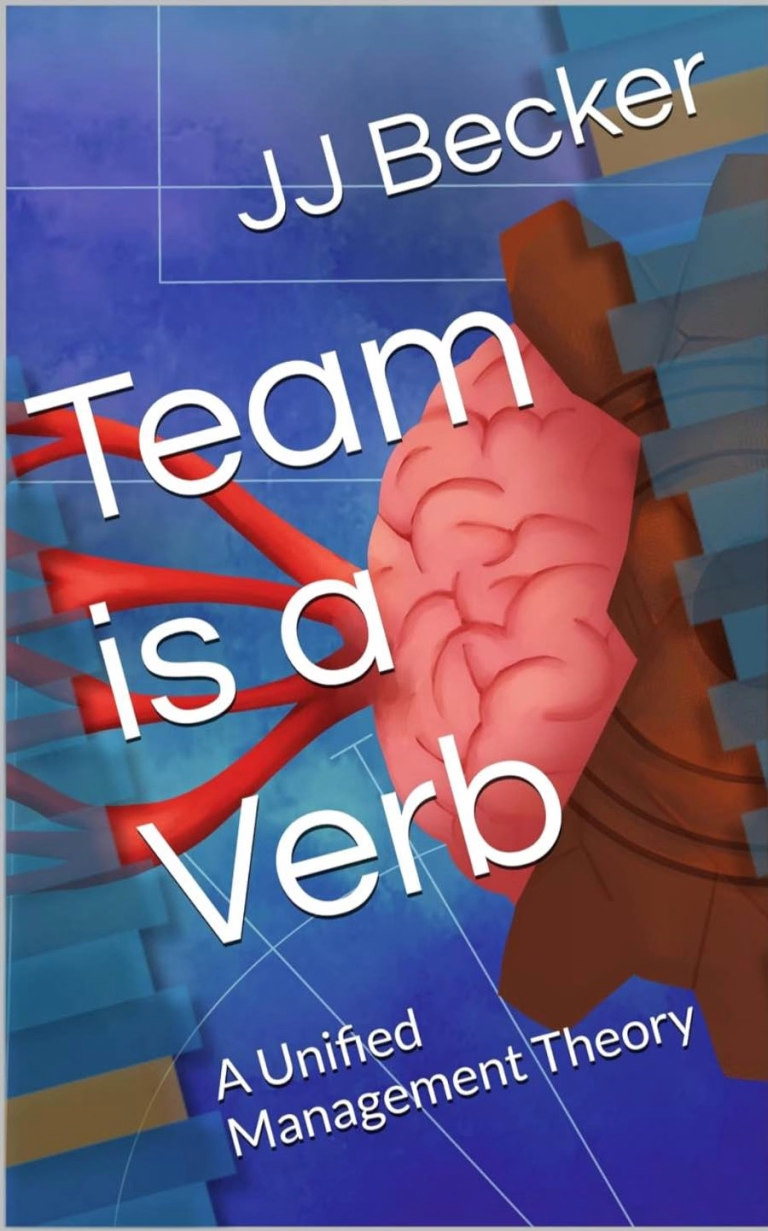
Leadership becomes most visible when plans are disrupted, pressure rises, and a team must decide what to do next. Team Is a Verb: A Unified Management Theory by JJ Becker examines those defining moments through a framework shaped by more than 25 years of operational experience.
Available in Kindle and paperback editions, the book is written for managers who need practical guidance that can function during real shifts, with real employees, and under genuine time pressure.
Leadership in Motion
The central idea behind Team Is a Verb begins with the title itself. A team isn’t a structure that a manager assembles once and considers complete. It’s an active relationship among people who must communicate, adapt, solve problems, and work toward a shared result every day.
JJ learned this through a career that began when he was 14 years old and working as a dishwasher. He advanced through every level of the food service industry, eventually overseeing large retail operations, multi-state bakery production, and teams numbering in the hundreds. His experience includes managing a supermarket that generated more than $50 million in annual revenue.
He has also worked in a small business with only three people. That contrast in scale gave him a broad view of team performance. In a large operation, one weak system can affect hundreds of employees. In a small shop, every individual represents a major portion of the available workforce.
Across these environments, JJ encountered a persistent gap between leadership theory and operational reality. Managers might understand goals discussed in a meeting, yet they still need a way to translate those goals into coordinated action. During a busy shift, they must respond quickly while preserving trust, clarity, and productivity.
His answer is Unified Management Theory, known as UMT. The framework brings together ideas from 37 thinkers and organizes them into a system that managers can use while planning, communicating, diagnosing problems, and responding to change.
From Four Pillars to Seventeen Buttresses
UMT is built around Four Pillars. These draw from Sun Tzu’s strategic thinking, W. Edwards Deming’s approach to systems, Dale Carnegie’s understanding of people, and Quantum Management Theory. Together, they support Kinesegrity, JJ’s framework for connecting strategic direction with the way people and systems move in daily operations.
The book then introduces the Seventeen Buttresses. These are practical diagnostic tools created for situations that frequently damage workplace performance. A manager may be dealing with an employee who resists change, a veteran worker who has become comfortable with minimal effort, or a promising new hire showing signs of burnout.
Other problems can be less obvious. A meeting may appear productive because everyone agrees, although no meaningful action follows. A team may seem prepared until an unexpected event reveals confusion about authority, communication, or priorities. The Buttresses help managers recognize these patterns and determine an appropriate response.
A dramatic Thanksgiving Eve incident brings the framework to life. An elderly customer’s shopping cart clips a folding table holding approximately 200 pies. The table buckles, sending apple and pumpkin pies toward the floor. Customers who had expected to purchase them begin abandoning carts filled with hundreds of dollars in groceries.
The disruption unfolds within seconds. There’s no comfortable opportunity for a long discussion. Employees must understand the urgency and begin rebuilding the bakery’s output immediately.
Five team members respond without waiting for detailed commands. They coordinate their efforts, recognize what each person can contribute, and move toward the same operational goal. JJ calls this response the Swarm.
The moment illustrates what can happen when a team has been prepared to think and act collectively. Employees become active participants in the solution. The manager’s earlier work provides the clarity that allows effective movement when circumstances suddenly change.
A Field Guide for Managers Under Pressure
Team Is a Verb combines professional memoir, management theory, and practical instruction. Its examples come from workplaces where customer expectations are immediate, production schedules matter, and leadership decisions influence what happens within minutes.
JJ writes for managers who have been given responsibility without receiving a complete guide to handling people, systems, and unpredictable events. His framework helps readers consider how team behavior develops over time and how a manager’s choices influence that development.
The lessons can apply to supervisors on a retail floor, leaders in food service, department managers, and anyone responsible for coordinating people in a demanding environment. Readers are encouraged to identify what suits their workplace and use those ideas to strengthen daily operations.
About the Author
JJ Becker has more than 25 years of experience leading high-volume retail and food service operations. His background includes single-store management, multi-facility businesses, large workforces, and organizations generating tens of millions of dollars annually.
His approach was developed through years of direct problem-solving and the study of 37 experts from several disciplines. Team Is a Verb brings that experience into one unified management framework designed for active leaders.
The Value of Showing Up as a Leader
A title may establish authority, but consistent action determines how leadership is experienced by a team. JJ’s book asks managers to treat leadership as something they practice during every shift, conversation, decision, and crisis.
For anyone whose workplace can change faster than a formal meeting can respond, Team Is a Verb offers an experience-driven framework for creating teams that understand the goal and know how to move toward it together.
We had the privilege of interviewing the author. Here are excerpts from the interview:
Thank you so much for joining us today! Please introduce yourself and tell us what you do.
I’m JJ Becker, and I’ve spent over 25 years leading high-volume retail and food service operations, from single stores to multi-facility operations grossing tens of millions annually. I’m also the author of Team Is a Verb, a leadership framework built from decades of real floor experience, reverse engineered and then resynthesized from the ideas of 37 different people who are experts in their various areas.
Please tell us about your journey.
I started in food service at age 14 as a dishwasher and worked my way up through every level of the business, eventually running departments and operations generating more than fifty million in annual revenue and leading teams of hundreds. Along the way, I kept running into the same problem: most management theory is written for boardrooms, not for the floor at 6 pm during a holiday rush. So I started building my own approach out of necessity, long before I ever thought about writing it down. Team Is a Verb is the result of putting 25 years of that real, tested experience into a single framework.
What are the strategies that helped you become successful in your journey?
My foundation rests on three thinkers I’ve carried with me since my twenties: Sun Tzu, W. Edwards Deming, and Bruce Tuckman. Sun Tzu taught me strategy and positioning, Deming taught me systems and continuous improvement, and Tuckman gave me a real framework for how teams actually develop over time. Over the years, I kept adding to that foundation, pulling in ideas from other thinkers along the way, always looking for a better way to see the same problem. On the floor, through every rush and every difficult shift, all of it got tested and built on until it became something of my own: a strategy that treats leadership as something you do, not something you have.
Any message for our readers?
If you manage people, especially in a fast-paced, high-pressure environment, this book was written for you, not for an academic audience. Take what works for your floor and leave the rest. Leadership isn’t a title, it’s something you do every single shift.
Thank you so much, JJ Becker, for giving us your precious time! We wish you all the best for your journey ahead!
Knowledge grows when shared. Please Pass it on!

Discover more from Paxjones
Subscribe to get the latest posts sent to your email.