
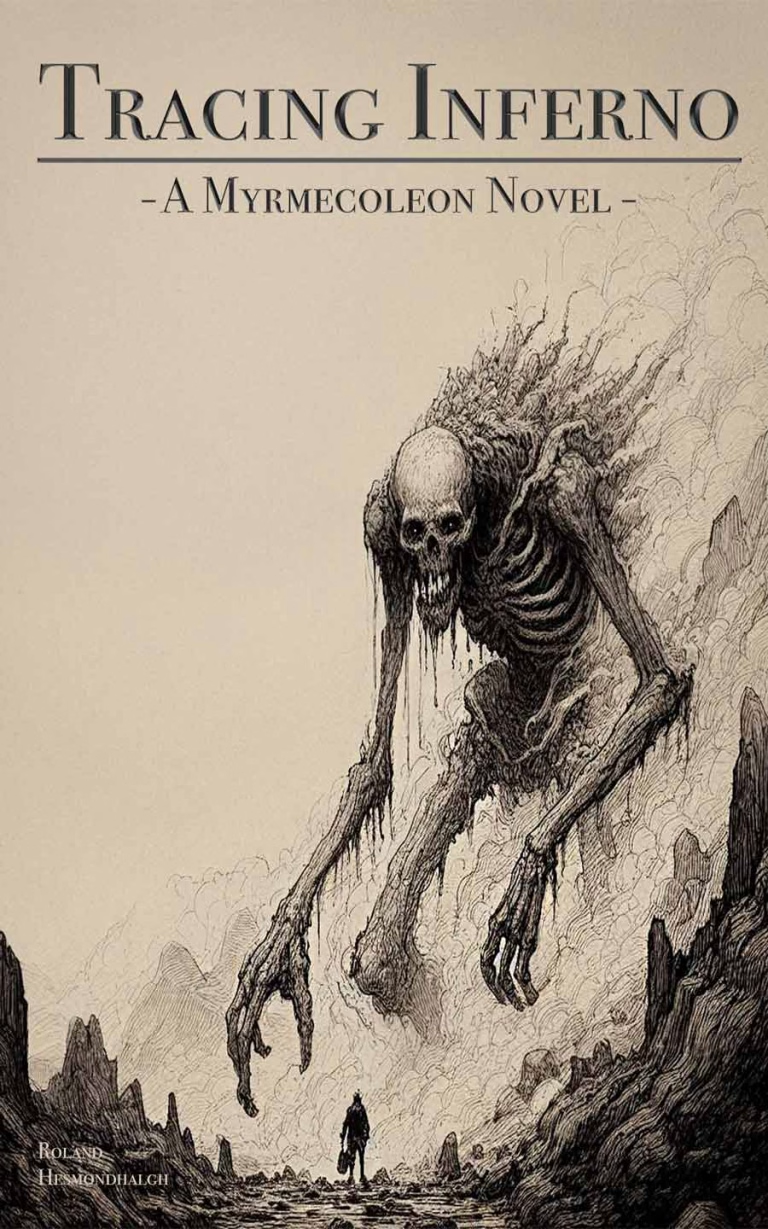
Few assignments begin with a soldier being awakened and ordered to enter the afterlife. In Roland Hesmondhalgh’s Tracing Inferno: A Myrmecoleon Novel, that startling command opens the door to an ambitious fantasy epic. The result is a journey shaped by danger, classical mythology, spiritual uncertainty, and memorable action.
First Steps Into the Inferno
The Myrmecoleon has died, leaving behind memories and the enormous influence he once held over the world. Those in power refuse to accept recollections as sufficient evidence. They want something tangible, final, and impossible to dispute. Even Heaven and Hell require proof of death, and Endeavor has been entrusted with providing it.
A young agnostic serving in Endeavor’s military, Zambrano is pulled from his sleep and handed a mysterious parcel. His instructions are simple in wording and terrifying in scope. He must travel alone to the deepest point of Hell and deliver the box. Locks, sigils, and secrets protect its contents, which are so dreadful that their existence confirms the Myrmecoleon’s death.
The mission sends Zambrano into territory where even Angels hesitate to go. During his passage through the nine circles, he meets tormented shades, mythic demons, and powerful beings that maintain the laws of the afterlife. Physical survival becomes only one part of his struggle. Every encounter pushes him toward questions about suffering, authority, personal responsibility, and the endurance of the human spirit.
Truth waits throughout Hell’s scorched landscapes. Some discoveries offer clarity, while others threaten to change how Zambrano understands existence itself. Looming over the entire expedition is a question with no comfortable answer: what does sin truly mean in the eyes of God?
An Epic Built on Dante, Art, and Suspense
With more than 181,000 words across 635 pages in the standard 5-by-8-inch format, Tracing Inferno gives readers a generously sized fantasy adventure. Its length supports an elaborate world, a large philosophical canvas, and enough action to keep the descent moving.
Roland studied mythology, and that knowledge informs his depiction of Hell. The setting closely follows the original structure presented in Dante Alighieri’s Divine Comedy. To confirm its accuracy before publication, Roland shared excerpts with a Harvard scholar who teaches classes about Dante. The scholar reviewed the material and endorsed the book.
Classical detail enters the story through characters, locations, and conflicts, allowing readers to encounter famous literary ideas through an accessible adventure. The learning happens naturally amid danger and occasional humor. Each circle of Hell has its own corresponding sketch. The three rings within the Seventh Circle also receive individual artwork, giving readers visual companions for important stages of the journey.
The narrative moves between two points in time. Odd-numbered chapters occur after the central events and follow Zambrano as he’s interrogated for answers. Even-numbered chapters contain his firsthand account of Hell. This pattern provides breathing room after intense sequences while building curiosity about what he experienced, what he carried back, and why others urgently need his testimony.
Readers are encouraged to form their own interpretations of individual scenes and characters. Symbolism, philosophy, and mythology create depth, although the central pleasures remain clear: compelling personalities, frightening obstacles, and energetic action.
The novel stands comfortably on its own. It also belongs to the literary universe of Roland’s ongoing science fiction and fantasy series, The Myrmecoleon, which is available on Amazon alongside Tracing Inferno. “Myrmecoleon” comes from a medieval bestiary and translates from Greek as “ant-lion.” Traditionally presented as an early Christian yin-yang creature, it reflects the series’ central interest in dichotomy and struggles between opposing extremes.
About the Author
Roland grew up moving between military bases in the United States and other countries while his family followed his father’s postings. Those international experiences contributed to his eye for detail and his ability to write for varied audiences.
Before concentrating on speculative fiction, he worked as a journalist across national outlets, broadcast media, and commercial projects. He earned a B.S. in Multiplatform Journalism from the Florida Institute of Technology, an M.P.S. in Communications and Journalism from Georgetown University, and an M.A. in Creative Writing from Harvard University.
Roland describes himself as classically trained and self-taught, a combination that gives his work an individual, brimstone-laced character. He writes science fiction, fantasy, contemporary fiction, and nonfiction, following stories wherever their characters lead. He currently lives in Tokyo, Japan, where he continues his valiant struggle with a powerful hirekatsu addiction.
Why This Journey Matters
Tracing Inferno offers spectacle, thoughtful symbolism, and a demanding voyage through one of literature’s most famous landscapes. Its shifting timeline, researched setting, illustrations, and philosophical questions give readers plenty to explore. Zambrano’s descent ultimately invites them to consider how power defines guilt, how people endure suffering, and whether every hard-won answer deserves to return from the dark.
Knowledge grows when shared. Please Pass it on!

Discover more from Paxjones
Subscribe to get the latest posts sent to your email.