
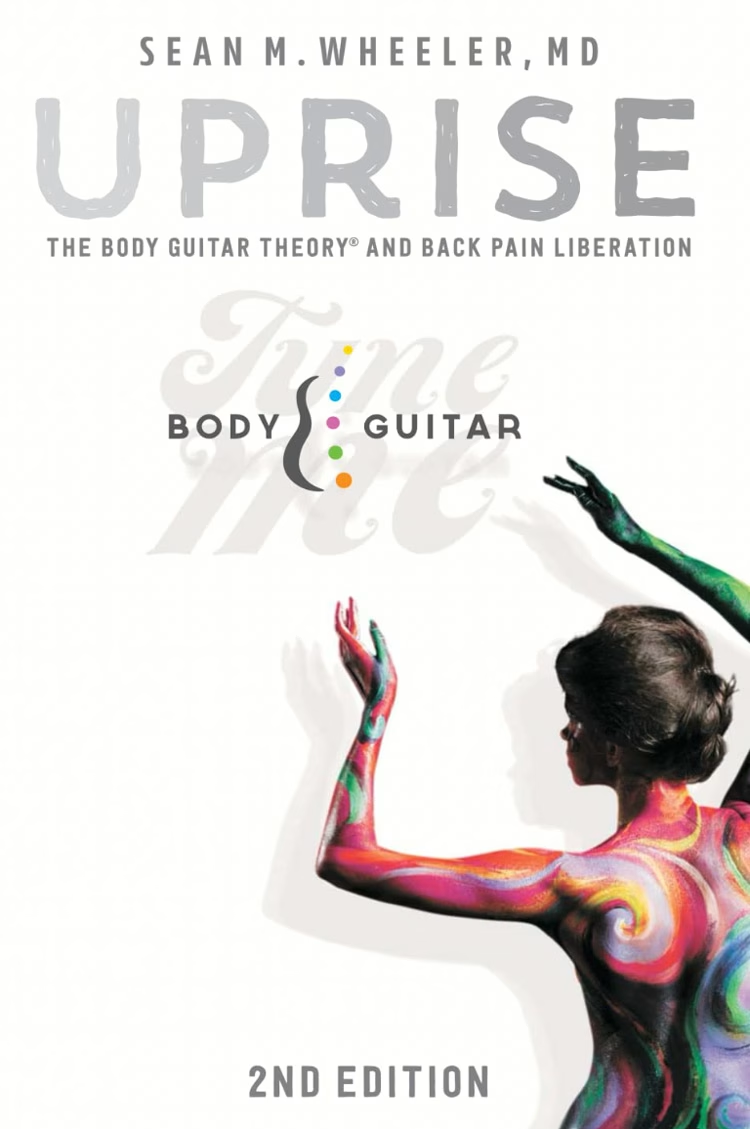
Chronic back pain affects millions, yet lasting relief remains rare. Uprise enters this conversation with a bold voice and a fresh framework. Dr. Sean M. Wheeler invites readers to reconsider what pain really means and how the body responds when it hurts.
Rethinking Chronic Back Pain From the Ground Up
For decades, chronic lower back pain has resisted long-term solutions. Medical advances have expanded imaging, surgery, and pain management tools, yet many patients remain stuck in recurring discomfort. Uprise begins by challenging the assumption that current approaches are enough. Dr. Wheeler poses a simple but unsettling question. What if the core problem has been misunderstood all along?
The book explains that chronic pain alters how the body functions. When the back hurts, specific muscles unique to humans weaken. These muscles play a central role in spinal stability and mobility, yet they often remain overlooked during diagnosis and treatment. As pain continues, weakness increases, movement patterns shift, and the cycle repeats. According to Dr. Wheeler, relief remains temporary because the root cause never receives focused attention.
Drawing from over twenty years of hands-on patient care, the author connects pain, instability, and muscle dysfunction in a clear, accessible way. He avoids jargon where possible and speaks directly to readers who feel frustrated, unheard, or worn down by repeated setbacks. The tone stays grounded in clinical reality while remaining deeply human.
The Body Guitar Theory Explained
One of the most compelling ideas in Uprise is the Body Guitar Theory. Dr. Wheeler presents the human body as a finely tuned instrument. When each component works in harmony, movement feels natural and strong. When one string slips out of tune, the entire instrument sounds off.
In this metaphor, chronic back pain represents an instrument that has lost alignment. Muscles fail to activate properly, the spine loses stability, and motion becomes strained. Traditional treatments often focus on isolated symptoms rather than restoring balance across the whole system. The Body Guitar Theory reframes healing as a process of retuning rather than repairing a single broken part.
The second edition introduces “Tune Me,” a new medical orchestration designed to bring the Body Guitar back into alignment. This approach emphasizes precise muscle activation, movement awareness, and restoring natural support systems. It reflects a shift away from passive treatments and toward strategies that engage the body as an active participant in recovery.
Readers gain a sense that healing is possible when the right elements work together. The idea resonates because it feels intuitive. Many already sense that their body functions as a whole, even if medical conversations sometimes fragment it.
Why Uprise Challenges the Medical Status Quo
Uprise stands out because it questions long-standing assumptions without dismissing medical science. Dr. Wheeler respects the tools of modern medicine while acknowledging their limits. When outcomes fall short, he argues that professionals must reexamine foundational beliefs.
The book gained early recognition when its first edition became Publisher Weekly’s National Book of the Week. That response reflected a growing appetite for perspectives that bridge clinical expertise with real-world patient experience. In this updated edition, Dr. Wheeler expands his insights with refined explanations and practical frameworks.
What makes the book approachable is its focus on understanding rather than blame. Patients are not portrayed as broken. Instead, they are described as individuals whose bodies adapted to pain in predictable ways. By understanding those adaptations, recovery becomes more achievable.

The Experience Behind the Insight
Dr. Sean M. Wheeler’s background reinforces the credibility of his message. His career spans family medicine, sports medicine, pain management, and surgical care. As one of the first physicians board-certified in both Sports Medicine and Pain Management, he brings a rare blend of perspectives.
His path began on the football field at Texas Christian University and Kansas State University, followed by medical training at the University of Kansas School of Medicine. He completed residency and fellowships in Fort Worth and trained with renowned orthopedic surgeon Dr. James R. Andrews. Over the years, he has served as a team physician for multiple collegiate athletic programs and spoken to medical groups nationwide.
This depth of experience shapes Uprise into more than a theory. It reflects decades of observation, treatment, and a willingness to question routines that no longer serve patients well.
A New Way Forward
Uprise offers readers clarity, hope, and a new lens for understanding chronic back pain. By viewing the body as an instrument that can be retuned, Dr. Wheeler opens the door to lasting change. For those ready to rethink pain and movement, this book provides a thoughtful starting point toward liberation.
We had the privilege of interviewing the author. Here are excerpts from the interview:
Thank you so much for joining us today! Why did you decide to write Uprise, a book about chronic pain and the interplay between pain, spinal instability, and muscle weakness?
Uprise was actually written out of frustration. I care deeply about the patients I treat. I feel that all of us do our part in this world. No one has all the gifts, all the answers, or all the skills, and therefore, we need each other. In doing my part, it fills my cup to take care of people and figure out their complex problems. With back pain, the advance of medical knowledge has been slow. The pain management world is focused on procedures or biopsychosocial dysfunction. None of which has provided long-lasting relief to a majority of patients. My ideas from 10 or 20 years ago are not what they are today, but today’s ideas are built upon those older ideas. Ideas that are all formed from frustration. The fruits of this frustration have been completely new ideas on how the spine is stabilized, how pain destroys this stability, how the body responds, and why this weakness rarely resolves. From this understanding, what emerged was a new understanding of arthritis, endurance muscle weakness, posture, aging, and a new vocabulary. A necessary new vocabulary is the most audacious thing I have proposed in this book. We need new words to differentiate the new ideas from the old ones. Not a rejection of the old words, but an addition to them. New words create new conversations. New conversations are the solution to frustration.
What is behind the name Body Guitar?
The name “Body Guitar” was formed by my good friend Steve Cranford, a genius in marketing, who was on my back porch singing songs in 2014 while I played guitar. In between songs, he told me that my idea that there were six places in the body that must be stabilized or the body would compensate sounded like the strings of an acoustic guitar. He proposed that I should call the book “Body Guitar”. I told him that that was the stupidest name and idea I had heard yet. The next week, he started sending me Body Guitar logos, and they won me over. In 2018, we opened The Body Guitar Clinic while everyone was telling me to call it something medical, like the Wheeler Institute, etc. In 2024, when I decided to write a new edition which included a new way of stabilizing the lumbar spine, much like an acoustic guitar is stabilized, even Steve was amazed. Steve died unexpectedly from a massive heart attack in March of 2025, but his memory will live on in this book and its ideas.
How is your approach to “pain” a disruptive innovation to understanding treatment for chronic pain?
This book is not a rehash of current beliefs in back pain or stability; it is a completely new re-imagining of these ideas. A new direction that has never been presented before. A pathway that brings many competing groups and ideas together. It is disruptive because of these new ideas, new solutions, and new lexicon. It is a revolution, an “uprise”.
Who is the target audience for your book?
The target audience is patients who are struggling. It is meant as a backdoor into the medical field. My approach should significantly decrease the number of surgeries, spinal cord stimulators, and other expensive procedures currently used in pain management, thus decreasing the physician and hospital profitability in the current insurance system. We are not, or should not be, in the profit business, but only have profit as a byproduct of good care. Right now we have profit without good care. Changing that system is hard. Convincing people in pain who are desperate for solutions is easier, and that’s the approach I took in this book.
What inspired you to enter the medical field?
My passion for medicine started early. No one in my family or extended family was in medicine. I was in Boy Scouts and loved the medical merit badges. Decades later, I saw my beloved seventh-grade teacher Mrs. Peggy Dalton, at a reunion, and the first question she asked me was: “Are you a doctor yet?” Medicine completes me professionally and continues to do so. I have patients whom I can pour my passion and love into as I try to figure out how to make their lives better.
How can people learn more about you, Uprise and Body Guitar?
Website: Bodyguitar.com
Instagram: @getyourbodyintune
Twitter/X: @DrSeanWheeler
Facebook: Bodyguitar Clinic
Thank you so much, Dr. Sean M. Wheeler, for giving us your precious time! We wish you all the best for your journey ahead!
Knowledge grows when shared. Please Pass it on!

Discover more from Paxjones
Subscribe to get the latest posts sent to your email.