

Intro
History often feels distant, yet some stories pull readers straight into the noise, grit, and ambition of another age. Fagan of Hoboken & the Horseshoe does exactly that, offering a vivid portrait of a man and a city colliding at full speed.
Written by Nicholas Fagan Dealy, the book brings to life an era when power, personality, and principle tangled daily on New Jersey’s waterfront.
A Mayor Forged in Conflict and Conviction

Lawrence Fagan did not rise quietly. His path to becoming Mayor of Hoboken in 1893 began with an act of open defiance that set the tone for everything that followed. Declaring he would rather cut his own throat than negotiate with a Democratic machine boss was a shocking statement, even in an age accustomed to political theatrics. Yet the voters responded, and Fagan won.
As mayor, Fagan governed during Hoboken’s most intense period of growth. Immigration surged, industries expanded, and the city strained under its own momentum. He served four consecutive terms, balancing reform with raw authority. His administration tackled police corruption at a time when law enforcement often answered to political favors rather than public duty. At the same time, he found himself mediating between temperance advocates and a booming saloon culture that reflected the habits of working-class life.
A catastrophic harbor and steamship fire in 1900 further defined his tenure. The disaster exposed the fragility of an industrial city built quickly and unevenly. Fagan responded with the same blunt resolve that marked his entire career, reinforcing his reputation as a leader who acted decisively under pressure.
Industry, Labor, and the Code of Manliness
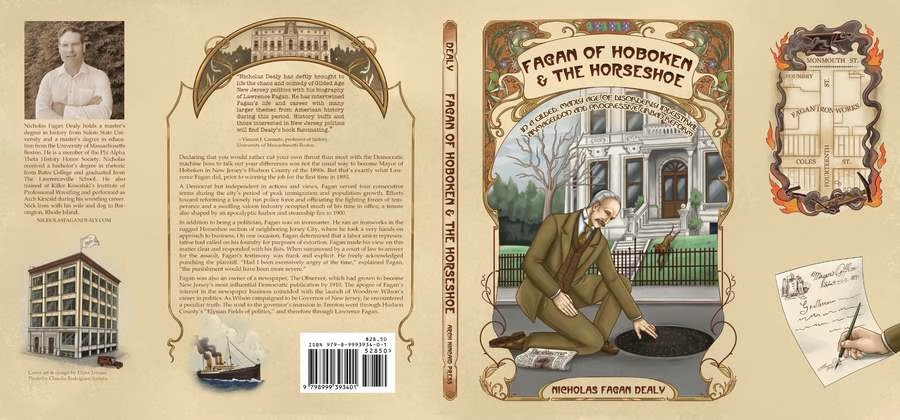
Politics was only one side of Lawrence Fagan’s world. He was also an ironmaster who ran an ironworks in the Horseshoe section of Jersey City, an area known for flooding, overcrowding, and relentless labor. Fagan remained deeply involved in daily operations, viewing management as a hands-on responsibility rather than a distant role.
That attitude extended to labor disputes. When he believed a union representative had approached his foundry with extortion in mind, Fagan reacted physically. His courtroom testimony following the assault was famously candid. He admitted to throwing the punch and explained that restraint had limited the damage. The episode captured the spirit of Gilded Age manliness that Dealy explores throughout the book, where physical toughness, pride, and authority blended seamlessly into public life.
Through these moments, Dealy presents Fagan as neither a caricature nor a hero. He appears as a product of his environment, shaped by immigrant hardship, industrial competition, and a belief that strength equaled legitimacy.
Power Beyond City Hall
Fagan’s influence extended well beyond Hoboken’s municipal boundaries. As the owner of The Observer, he controlled one of New Jersey’s most influential Democratic newspapers by 1910. Journalism became another tool through which he shaped public opinion, challenged rivals, and promoted reform causes.
The height of his media power aligned with the early political rise of Woodrow Wilson. As Wilson campaigned for governor, he discovered an unavoidable reality. Success required passage through Hudson County’s dense political landscape, and Fagan stood firmly at its center. Dealy illustrates how local power brokers like Fagan played a decisive role in launching national figures, reminding readers that American politics often moved upward from crowded city streets rather than downward from lofty ideals.
This blending of media, industry, and governance forms one of the book’s strongest threads. Dealy shows how Fagan navigated these spheres with confidence, creating influence that few contemporaries fully understood.
Why This Story Still Matters
Fagan of Hoboken & the Horseshoe works as both biography and micro-history. Dealy uses Fagan’s life to explain broader forces shaping urban America during the Gilded Age and Progressive Era. Immigration, class mobility, political reform, and urban disorder all emerge naturally through lived experience rather than abstract theory.
The movement between the Horseshoe and Hoboken’s elite heights becomes a powerful lens for understanding how cities functioned. Fagan crossed social and physical boundaries with ease, embodying the possibilities and tensions of an industrial nation finding its footing.
For readers interested in political history, labor history, or the immigrant experience, the book offers clarity without sacrificing drama. It shows how progress often arrived through flawed individuals operating in imperfect systems.
Conclusion
Dealy brings readers face to face with a man who helped shape his city through force of will and relentless presence. Fagan of Hoboken & the Horseshoe proves that understanding one life can unlock the story of an entire era, making history feel immediate, human, and sharply relevant today.
Knowledge grows when shared. Please Pass it on!

Discover more from Paxjones
Subscribe to get the latest posts sent to your email.