
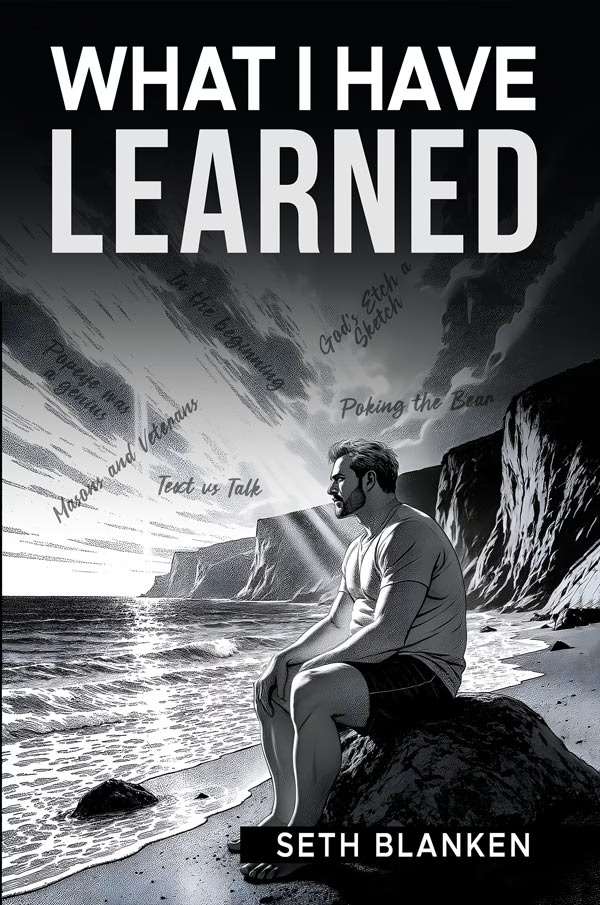
A Life in Words: Seth Blanken’s “What I Have Learned”
Some books read like a story. Others, like a confession. What I Have Learned by Seth Blanken feels like a long, honest talk with someone who’s been through a lot—and isn’t afraid to share it. It’s part memoir, part reflection, and part stand-up routine at times. You never quite know what’s coming next, and that’s what makes it so engaging.
The Heart Behind the Pages
From the first page, Seth’s words don’t just tell—they invite. The book swings between quiet reflection and raw humor, as if you’ve stumbled into a late-night chat where he’s pulling memories off the shelf and examining them under warm light.
He doesn’t bother dressing things up. Life, as he describes it, is a series of odd turns, bold experiments, and moments that make you stop and laugh because—well—it’s the only thing that makes sense to do. Through every chapter, you can feel him reaching for connection, hoping that his stories might spark something familiar in whoever’s reading.
And it works. The tone’s easy, conversational, but there’s depth in every line. Whether Seth’s reflecting on creative work, career pivots, or simple lessons learned the hard way, the voice stays human—unfiltered and grounded.
The Story of a Storyteller
Before What I Have Learned ever existed, Seth’s creative path was already rich with reinvention. He’s the kind of person who doesn’t just dream up ideas—he builds them, tests them, lets them live for a while, and moves on to the next adventure.
Back in 2017, after years in the film and production world, he launched TruPOV. It was a platform made to deliver vivid, headset-free experiences—mountain biking, drag racing, amusement park rides, even meditative moments—for children in hospitals and for veterans craving a taste of adventure again. It was empathy expressed through technology, and that alone says a lot about how Seth approaches creativity.
When the project wrapped, he didn’t pause. Instead, he turned back to something old—a story from the ’90s he’d once written as a movie. That idea transformed into a massive, ten-book saga. Cryptography, hidden worlds, secret agencies—each book feeding into the next, all the way to Rogue Agent, where the big picture finally comes together.
That kind of scope takes imagination and persistence. It’s the mark of a mind that sees patterns others might miss. And while What I Have Learned isn’t fiction, it carries the same curiosity that fuels his other work. You can tell he’s someone who never stops asking “why?”
Lessons from a Career of Constant Creation
By day, Seth’s a technical writer. He’s worked with some of the biggest names out there—Lockheed Martin, Northrop Grumman, CareFirst BlueCross BlueShield, and T. Rowe Price. Eighteen years of experience have made him fluent in structure, logic, and precision. Yet, that’s only half of who he is.
Because after hours, another voice emerges—the storyteller. The one who created AI from a Creative Writer’s Perspective, diving into how artificial intelligence and imagination intersect. The one who wrote Tales from an Escapee of Camp Krazy, reflecting on his time at Lockheed Martin with humor and insight.
That duality is fascinating. There’s a certain balance between the technical and the emotional in everything Seth writes. He understands order—but he also knows the beauty of chaos. In What I Have Learned, that blend is clear. It’s structured enough to follow easily, yet unpredictable enough to keep you turning the pages.
Finding Meaning in the Moments
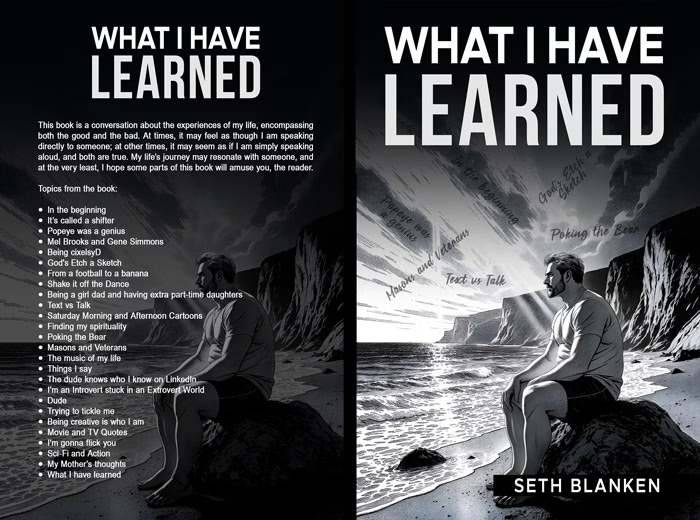
If you’re looking for a step-by-step guide to life, this isn’t it. Seth’s book doesn’t claim to have answers. Instead, it offers perspective—a mosaic of experiences, shaped by trial, curiosity, and humor. Some chapters are introspective. Others, simply fun. Together, they form something far more valuable than advice: honesty.
He talks about work, writing, reinvention, and the small details that often go unnoticed. You can tell that each story comes from somewhere genuine—no embellishment, no overthinking. It’s the rawness that makes it relatable.
Seth doesn’t push readers toward any grand takeaway. Instead, he hands them pieces of his own journey and lets them see what fits. Maybe it’s the reminder to laugh at life’s absurdities. Maybe it’s the quiet encouragement to keep creating even when interest fades. Whatever it is, you walk away lighter.
Why “What I Have Learned” Feels Different
The magic of this book lies in how effortlessly it moves. The rhythm of Seth’s storytelling mirrors life itself—unsteady, colorful, and full of unexpected laughter. It’s written by someone who’s lived deeply and worked across every creative field you can imagine, from screenwriting to corporate documentation.
You don’t read this book for structure or plot. You read it for connection. For that familiar voice that says, “Yeah, I’ve been there too.”
Seth’s reflections remind you that every twist and stumble has value. Every project, even the ones that fail, adds to the story. And every laugh, no matter how small, is worth remembering.
So, if you’re in the mood for a conversation disguised as a book—something real, unpolished, and unexpectedly funny— What I Have Learned might just be your next favorite read. You can find it on Amazon, waiting like an old friend ready to tell you everything he’s figured out… so far.
We had the privilege of interviewing Seth Blanken. Here are excerpts from the interview.
Hi, it’s great to have you with us today! Please share about yourself with our readers.
Hi, I have been a technical writer in both the IT and commercial arenas for over 18 years. I previously worked in the movie and commercial production arenas back in the 1990s. These days, I work as a proposal advisor to an international data center and IT company.
Please tell us about your journey.
My journey started back in the 1990s when I was working in the movie and commercial production business. While reading scripts, I realized that the stories I was writing on my own in my spare time could be turned into a script for a movie or TV series. When producers and stunt friends read my treatment, I was told I was on the right path, just that my thoughts were too far ahead of where the graphics were able to take me at that time. So, I tabled my ideas until 2017, when I decided to write out my stories and get them posted on Amazon.
What are the strategies that helped you become successful in your journey?
Cross-Pollinate Passions: I fuse cryptography, conspiracies, and real-world tech (e.g., Lockheed and DoD/Air Force insights) into fiction, making stories feel alive and layered. Iterate Fearlessly: TruPOV lasted a year—valuable data, not failure. I pivoted that 1990s script into books, then expanded into a 10-book universe. Build in Phases: Start small (Project Cipher), validate, then scale (full series + coloring books). Rogue Agent was planned as the connective keystone from day one. Leverage Day-Job Superpowers: Technical writing hones clarity, deadlines, and complex systems—skills that make my novels airtight and my nonfiction credible. Audience-First Mindset: TruPOV targeted kids and vets; the series hides puzzles for crypto fans; coloring books invite tactile engagement. Success = resonance. Persist Through Plateaus: Interest wanes? Archive and reboot. Every “end” is R&D for the next breakthrough. Document the Meta: What I Have Learned and Camp Krazy turn lived experience into IP, closing the loop between life and art.
Any message for our readers?
I hope readers enjoy the books I’ve written and the companion coloring books I’ve created. Thank you for taking the time to check them out.
Thank you so much for giving us your precious time! We wish you all the best for your journey ahead!
Knowledge grows when shared. Please Pass it on!

Discover more from Paxjones
Subscribe to get the latest posts sent to your email.