
The Meeting That’s Quietly Shaping Your Culture
There’s a meeting that shows up every week on nearly every manager’s calendar. It lasts about 30 minutes. It feels routine. It rarely feels transformative.
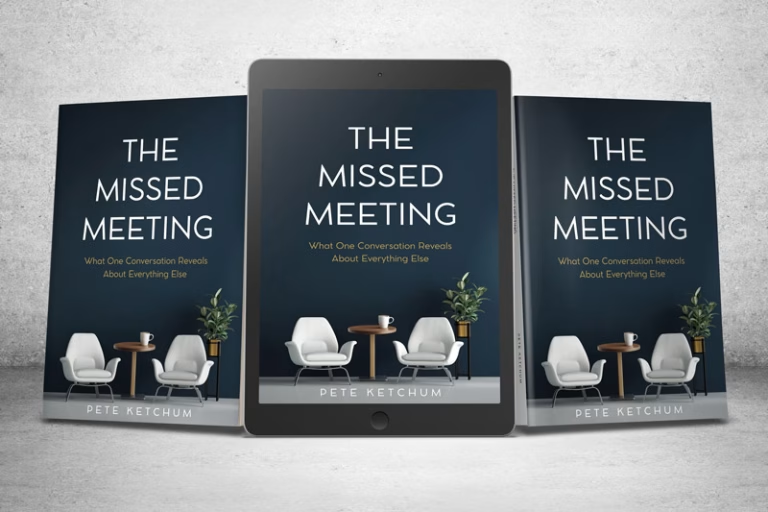
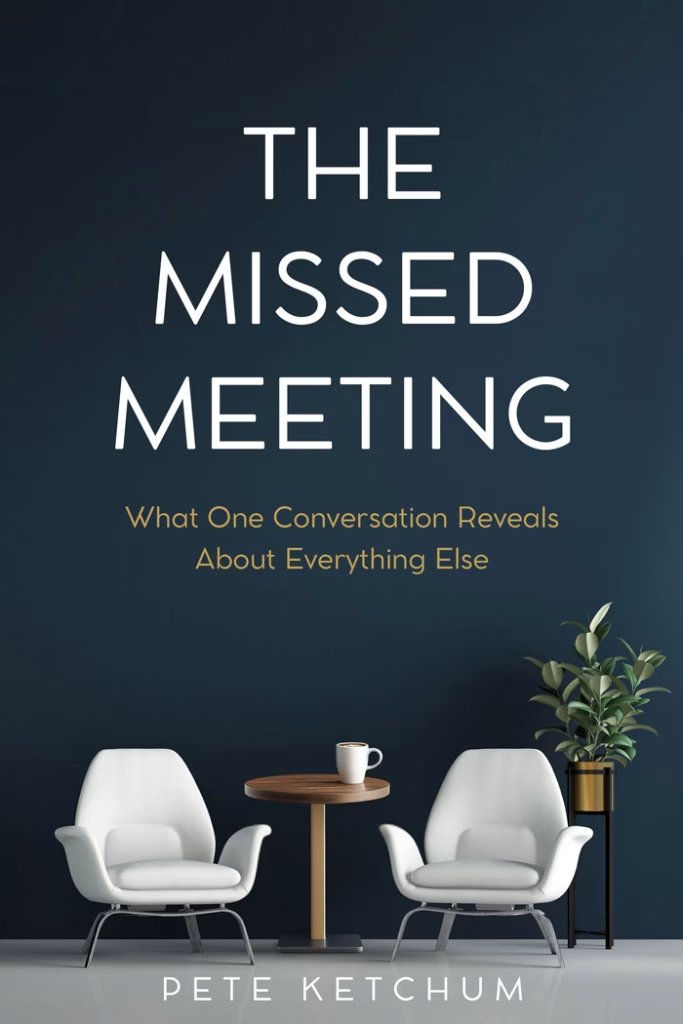
In The Missed Meeting: What One Conversation Reveals About Everything Else, Pete Ketchum argues that this ordinary one-on-one is anything but ordinary. It is the most underutilized diagnostic tool in modern organizations. And when it fails, it reveals far more than leaders realize.
The book, currently available for pre-order and set to release on March 23, 2026, takes aim at a familiar frustration. Managers believe they are investing in their people. Employees show up prepared. Updates are shared. Action items are documented. Yet engagement drifts. Retention slips. Performance plateaus.
Pete’s central claim reframes the problem. “Organizations run on a Mechanical OS: Compliance, Control, and Transactions. Humans run on a different operating system entirely: Autonomy, Competence, and Relatedness. The mismatch is where motivation goes to die.”
That mismatch, he explains, is what turns meaningful conversations into calendar clutter.
A Background That Changes the Lens

Pete did not arrive at this insight through abstract theory alone. His early career unfolded in environments where conversations carried weight. In the military, he trained as an interrogator, learning how to build rapport under pressure and read what was left unsaid. He later worked as a de-escalation specialist in a state prison and as a state trooper navigating volatile roadside encounters.
“Most business authors come from consulting firms or business schools. I came from an interrogation room. That background taught me something no MBA program does: how to read the conversation someone isn’t having with you.”
That skill set followed him into civilian leadership roles across finance, construction, government, and tech. Then came a humbling realization. After managing high-stakes interviews in extreme settings, he struggled in a standard workplace one-on-one. The meeting was polite. It was structured. It accomplished very little.
That moment sparked deeper study. Pete Ketchum earned an M.S. in Industrial-Organizational Psychology from Purdue University and grounded his observations in Self-Determination Theory, the research developed by Edward Deci and Richard Ryan. “Deci and Ryan proved what good leaders have always sensed: people don’t need to be motivated. They need to stop being demotivated. This book takes that science and makes it operational.”
The Real Cost of Getting It Wrong
Workplace disengagement is often framed as a communication issue. Pete pushes back. “The $1.2 trillion annual cost of ‘poor workplace communication’ isn’t a communication problem. It’s a psychological mismatch problem.”
Most people already want to contribute. “Most people don’t need to be incentivized to do good work. Give them meaningful tasks and reasonable autonomy, and they’ll outperform any bonus structure you could design. This isn’t wishful thinking. It’s psychology.”
Yet organizations frequently build systems that chip away at autonomy, competence, and relatedness. Leaders try to compensate with incentives, perks, and performance plans. The underlying friction remains.
Pete describes the one-on-one as a warning signal. “The one-on-one is like a check engine light. When it flashes, you can put tape over the dashboard, or you can look under the hood. Most leaders reach for the tape.”
When feedback feels tense, when conversations stay surface-level, when commitments quietly dissolve, the issue rarely sits with one individual. It reflects the broader system.
He shares a case study of a mid-sized tech company that lost $4 million through a failed executive hire and cascading turnover. For eight months, executives held pleasant but ineffective one-on-ones. No one felt safe enough to surface hard truths. Revenue suffered. Talent walked out the door. The meetings looked healthy. The culture was not.
“Companies are spending millions trying to add motivation when the real problem is they’re destroying it. The one-on-one is where that destruction becomes visible, if you know what to look for.”
Turning Conversations Into Leverage
Rather than offering generic advice about better listening, The Missed Meeting provides structure. Pete introduces the Sustain-Improve Framework, built around how people actually process feedback. He outlines meeting cadences tailored to role and psychological need. He includes the ARC Self-Assessment to help leaders diagnose friction across autonomy, relatedness, and competence.
He challenges common assumptions about recognition and feedback. “Recognition isn’t the soft stuff before the real conversation. Recognition IS the real conversation. It creates the conditions where growth becomes possible.”
He also reframes resistance. “The employee who ‘can’t take feedback’ often can. They just can’t take feedback delivered in a way that triggers their threat response.”
Follow-through receives equal emphasis. “Every commitment in a one-on-one is a small promise. Keep enough of them, and trust compounds. Break enough of them, and the meeting itself stops mattering.”
The message resonates with a specific audience. “This book is for the executive who senses something is off but can’t pinpoint it. The one who’s tried the engagement surveys, the pizza parties, the wellness apps, and still watches good people leave. The answer isn’t another program. It’s understanding what you’re accidentally doing to the motivation that was already there.”
Pete’s tone remains direct and practical throughout. The book is concise, research-backed, and free from corporate platitudes. It asks leaders to reconsider the most familiar meeting on their calendar and to treat it as a mirror.
When leaders learn to see what that mirror reflects, they often discover that the conversation they thought was routine has been telling them the truth all along.

We had the privilege of interviewing the author. Here are excerpts from the interview:
Hi, thank you so much for joining us today! Please introduce yourself and tell us what you do.
I’m Pete Ketchum, an industrial-organizational psychologist. I work with founders and executives who sense their organizations have stopped working the way they used to, and I help them figure out why. My book, The Missed Meeting, makes the case that most of what companies try to fix through culture programs and engagement initiatives is actually a psychological mismatch problem. Organizations run on compliance, control, and transaction. Humans are wired for autonomy, competence, and relatedness. That gap is where motivation goes to die, and the one-on-one meeting is where it becomes visible.
Please share your journey with our readers.
Most organizational psychologists come through academia or consulting. I came through interrogation rooms, prison yards, and the side of the highway.
I trained in military human intelligence, worked corrections as a de-escalation specialist, and served as a state trooper. Each role put me in situations where I had to build trust quickly with people who had no particular reason to extend it, and where getting it wrong had real consequences.
I later earned my master’s in industrial-organizational psychology from Purdue and moved into corporate leadership. That’s where I ran into the failure that eventually became this book. In my third week as a manager at a tech company, I sat down for a one-on-one with a veteran employee. I brought a printed agenda, asked methodical questions, and deployed silence the way I’d been trained to. At the end of thirty minutes, she looked at me and asked, genuinely puzzled: “Do we have to keep doing this?”
She wasn’t being rude. She was asking whether there was any value in returning to a conversation that had made her feel controlled, underestimated, and invisible. That question pulled me into the research on human motivation, and what I found there changed how I think about organizations entirely.

What are the strategies that helped you become successful in your journey?
The first thing was accepting that my background was an asset rather than something to explain away. The business world tends to treat military interrogation and corrections work as unrelated to organizational psychology. But those environments taught me how people actually behave under pressure, not how they behave in surveys. That perspective lets me see patterns that a more conventional background might smooth over.
The second was following the research rather than the conventional wisdom. Self-Determination Theory proved what good leaders have long sensed: people don’t need to be motivated. They need to stop being demotivated. The implications for how organizations are designed are significant and almost entirely ignored in mainstream management. Staying close to what the science actually says kept me from recycling the same advice everyone else was giving.
The third was staying honest about my own failures. The story at the center of this book is a story about getting it badly wrong. There’s a temptation to lead with your wins and bury the losses in a footnote. But the failure is where I learned something real, and being direct about it gave me something worth saying.
Any message for our readers?
The most expensive problems in your organization probably aren’t showing up in your dashboards. They’re the meeting where nobody says what they actually think. The top performer who leaves citing “growth opportunities” that were never discussed. The project that missed its deadline because someone didn’t feel safe raising a concern six weeks earlier.
None of that comes from bad intentions. It comes from well-intentioned systems that accidentally work against human nature. Organizations are built for compliance and transaction. People are built for autonomy, competence, and connection. When those two operating systems collide, the people lose, and the business pays for it.
You don’t need another engagement program. You need to stop blocking motivation that was already there. Start with one conversation. Run it differently. Then ask yourself where else that same pattern might be hiding.
That question is where the real work begins.
Thank you so much, Pete, for giving us your precious time! We wish you all the best for your journey ahead!
Knowledge grows when shared. Please Pass it on!

Discover more from Paxjones
Subscribe to get the latest posts sent to your email.